
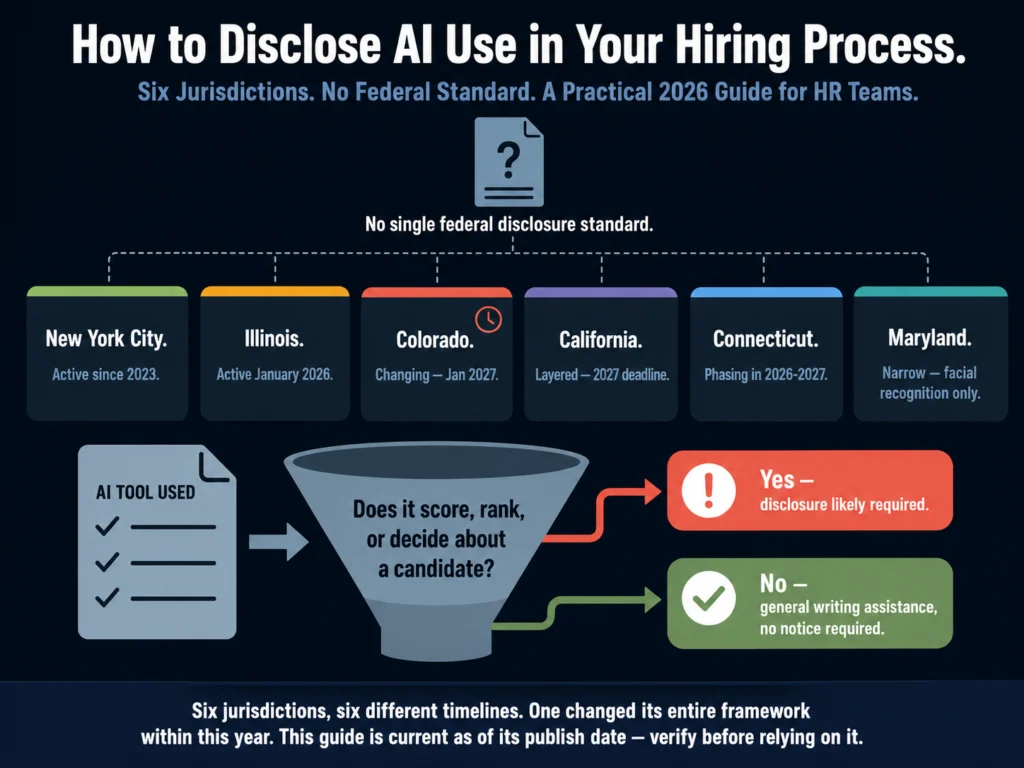
- Six jurisdictions now have active or imminent AI hiring disclosure requirements: Illinois, California, Colorado, New York City, Connecticut, and Maryland. There is no single federal standard.
- Colorado’s framework changed in 2026. The original Colorado AI Act (SB 24-205) was repealed and replaced by a narrower law, SB 26-189, effective January 1, 2027. If you read an article describing Colorado’s “impact assessment” requirements as currently active, it may be describing a law that no longer exists in that form.
- The disclosure obligation depends on what the AI actually does. A tool that scores, ranks, or filters candidates triggers disclosure requirements in most of these jurisdictions. A general AI writing assistant used to draft job postings, where a human makes every hiring decision, generally does not.
- This guide gives you a five-step framework for determining what to disclose, where, and in what language, plus sample notice text you can adapt.
- California vetoed a broad AI notice bill in October 2025, but separate CPPA Automated Decision-Making Technology rules carry a January 1, 2027 compliance deadline for CCPA-covered businesses, the same year as Colorado.
The compliance challenge with AI hiring disclosure is not the lack of clarity around any single requirement.
It is that there are six different requirements, in six different jurisdictions, written at six different times, by six different legislatures that were not coordinating with each other.
Illinois, Colorado, Connecticut, Maryland, California, and New York City have all established rules requiring employers to notify candidates, obtain consent, provide disclosures, or demonstrate fairness when using AI in employment decisions, according to a June 2026 ClearanceJobs compliance analysis.
What makes this genuinely difficult for HR teams is that these laws are not static. Colorado’s original comprehensive AI Act was repealed and replaced in 2026 by SB 26-189, a narrower law that eliminates the impact assessment and duty-of-care requirements from the original statute, effective January 1, 2027.
Any guide written before that change describes a law that no longer exists in its original form.
This article reflects the current state of the law as of May 2026, and the regulatory landscape will likely shift again before this article’s next review cycle.
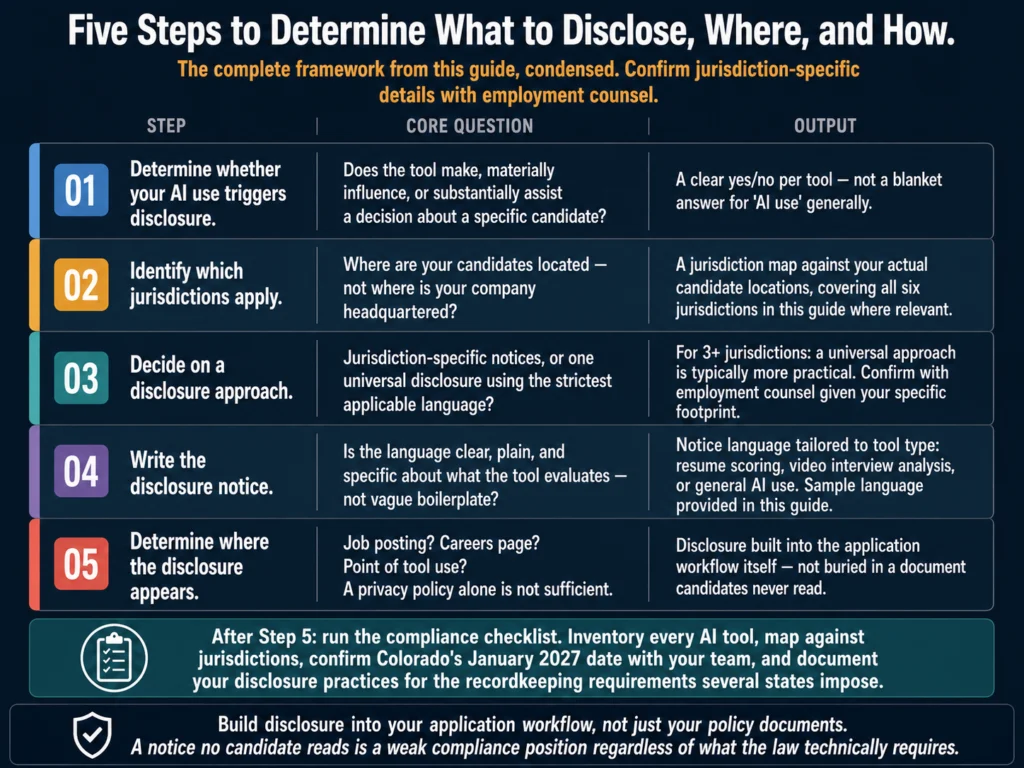
- Step 1: Determine Whether Your AI Use Actually Triggers a Disclosure Obligation
- Step 2: Identify Which Jurisdictions Apply to You
- New York City — Local Law 144 (in effect since July 2023)
- Illinois — HB 3773 (effective January 1, 2026)
- Colorado — SB 26-189 (effective January 1, 2027), replacing the original AI Act
- California — Multiple Overlapping Frameworks
- Connecticut — SB 5 (phasing in October 2026 through October 2027)
- Maryland — HB 1202 (facial recognition specific)
- Step 3: Decide on a Disclosure Approach
- Step 4: Write the Disclosure Notice
- Step 5: Determine Where the Disclosure Should Appear
- A Compliance Checklist Before You Finalize Your Approach
- Related Reading
- Frequently Asked Questions
- Conclusion
Step 1: Determine Whether Your AI Use Actually Triggers a Disclosure Obligation
Not every use of AI in your hiring process triggers a legal disclosure requirement.
The trigger, across nearly every jurisdiction covered in this guide, is whether the AI tool makes, materially influences, or substantially assists a decision about a candidate.
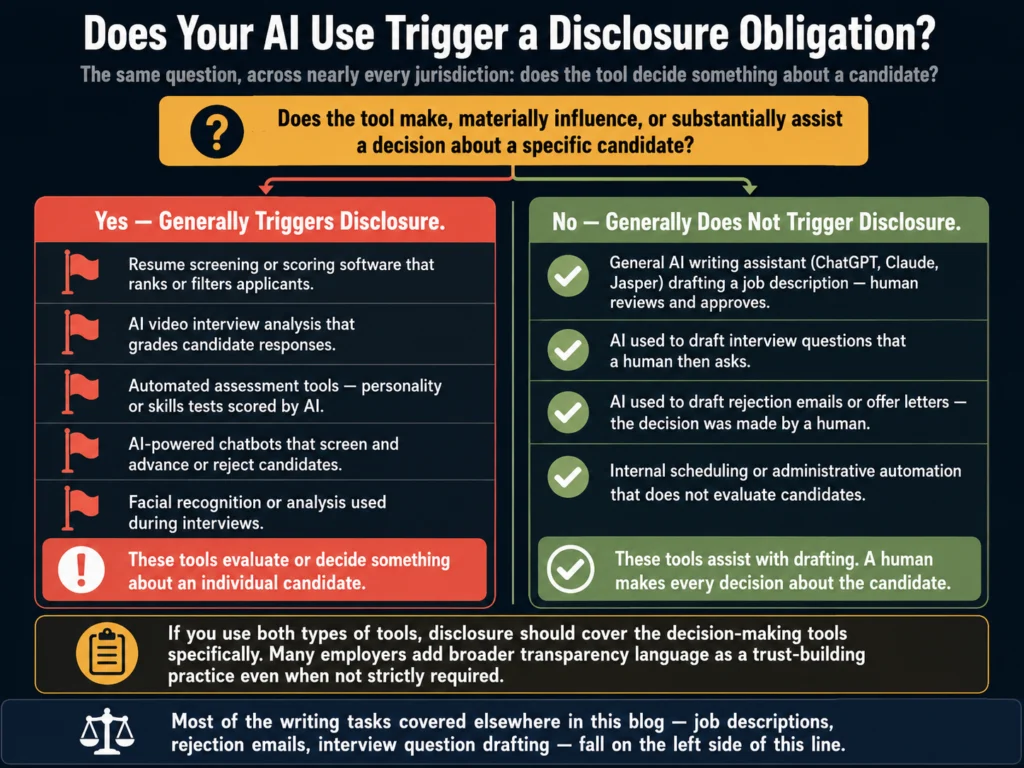
Tools that generally trigger disclosure requirements:
- Resume screening or scoring software that ranks or filters applicants
- AI video interview analysis that grades candidate responses
- Automated assessment tools (personality tests, skills tests scored by AI)
- AI-powered chatbots that screen candidates and advance or reject them
- Facial recognition or analysis used during interviews
Tools that generally do not trigger disclosure requirements under most current laws:
- A general AI writing assistant (ChatGPT, Claude, Jasper) used to draft a job description, where a human reviews and approves before posting
- AI used to draft interview questions that a human then asks
- AI used to draft rejection emails or offer letters, where the decision itself was made by a human
- Internal scheduling or administrative automation that does not evaluate candidates
The distinction matters because the disclosure requirements in this guide are written around automated decision-making, not AI-assisted drafting.
If you are using AI exclusively for the writing tasks covered elsewhere on this blog (job descriptions, rejection emails, interview question drafting), you are likely not within scope of most current disclosure mandates.
If you also use AI-powered resume screening, video interview scoring, or chatbot-based candidate evaluation, you are.
For organizations using both types of tools, disclosure should cover the decision-making tools specifically, though many employers choose broader transparency language covering all AI use in hiring as a trust-building practice.
Step 2: Identify Which Jurisdictions Apply to You
Disclosure requirements apply based on where the candidate is located, not where your company is headquartered.
A company based in Texas hiring a remote employee in New York City is subject to NYC’s requirements for that role.
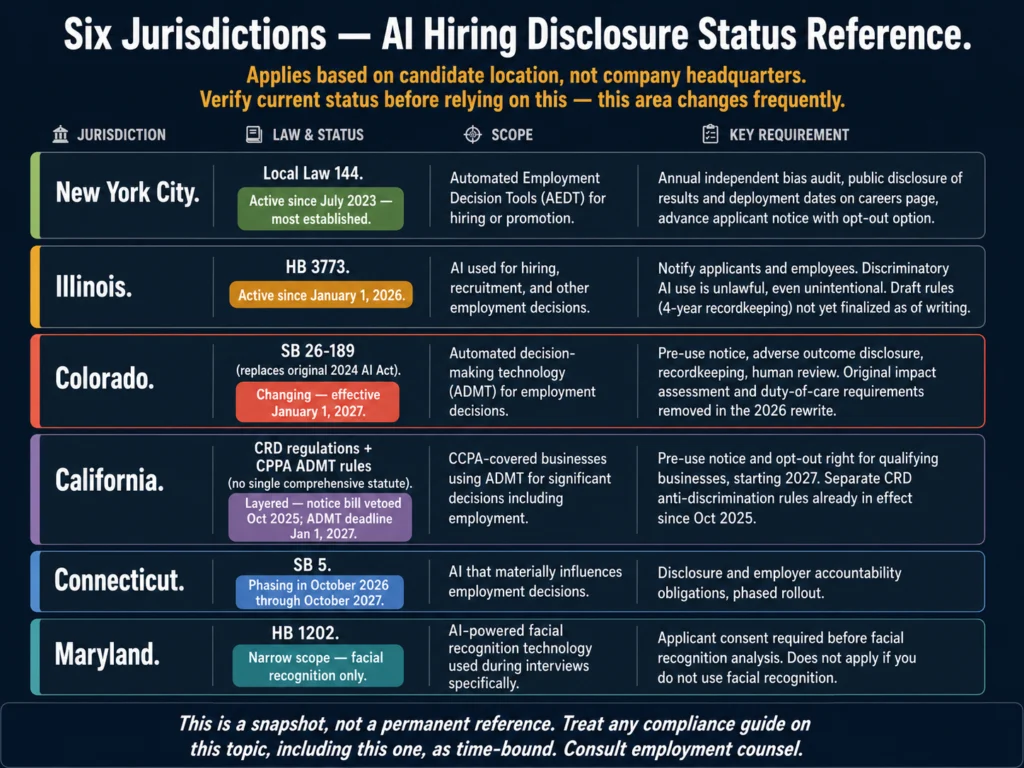
New York City — Local Law 144 (in effect since July 2023)
Noncompliance can result in fines of $500 to $1,500 per violation.
This is the most established and most actively enforced AI hiring disclosure law in the United States.
It applies to any employer using a qualifying AEDT to evaluate a candidate for a position located in New York City, regardless of where the employer itself is based.
Illinois — HB 3773 (effective January 1, 2026)
Illinois amended its Human Rights Act, effective January 1, 2026, to require employers to notify applicants and employees that AI will be used for hiring, recruitment, and other employment decisions, and explicitly makes discriminatory use of AI in employment decisions unlawful, even when unintentional.
Draft rules from the Illinois Department of Human Rights would require employers to preserve notices, postings, and disclosures regarding AI use for four years, and apply broadly to employers and their agents, including recruiters and third parties acting on the employer’s behalf.
As of this writing, these rules are in draft form following a stakeholder meeting and have not yet been formally published for public comment.
Illinois also has a separate, older law specific to video interviews: the Artificial Intelligence Video Interview Act (in effect since 2020), which requires candidate consent before AI-based video evaluation.
Colorado — SB 26-189 (effective January 1, 2027), replacing the original AI Act
This is the jurisdiction where the law has changed most significantly in 2026.Colorado’s revised law, SB 26-189, regulates automated decision-making technology (ADMT) and replaces the state’s landmark 2024 AI Act with a narrower framework, eliminating the original law’s impact assessment and duty-of-care requirements, effective January 1, 2027.
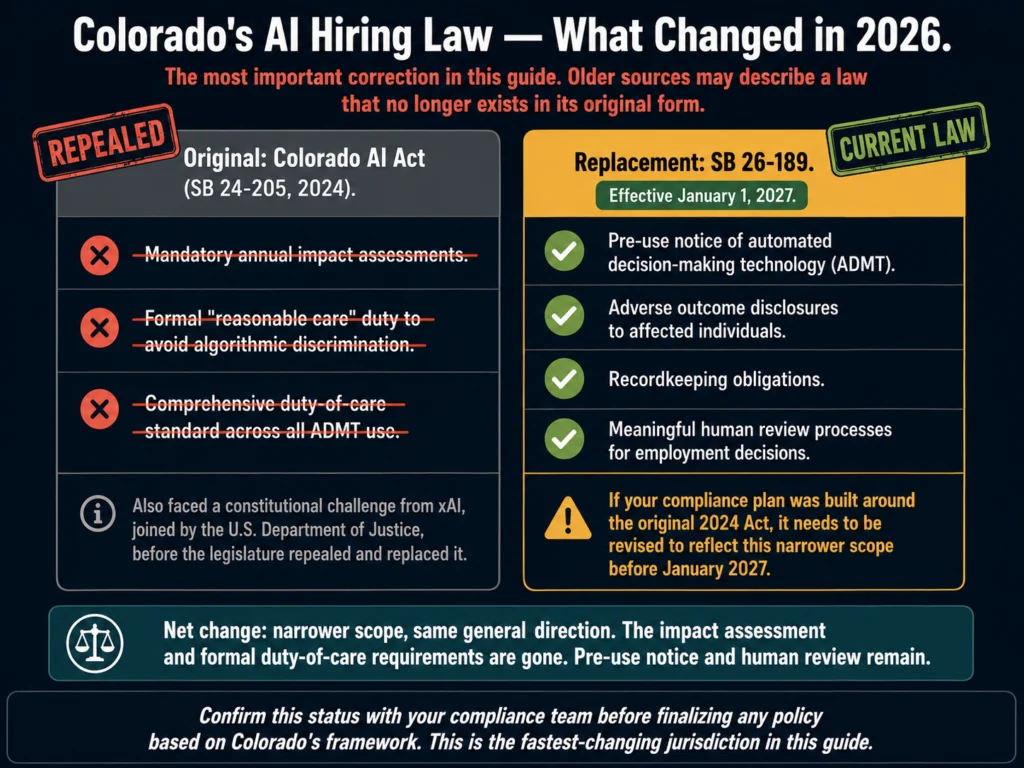
What remains under the new framework: pre-use notice of ADMT, adverse outcome disclosures to affected individuals, recordkeeping obligations, and meaningful human review processes for employment decisions.
What was removed: the mandatory annual impact assessments and the formal “reasonable care” duty that defined the original 2024 statute.
If your compliance plan was built around the original Colorado AI Act, it needs to be revised to reflect SB 26-189’s narrower scope before the January 2027 effective date.
The original AI Act had also been facing a constitutional challenge from xAI, joined by the U.S. Department of Justice, before the legislature repealed and replaced it. Worth remembering: this jurisdiction has been in flux from multiple directions at once.
California — Multiple Overlapping Frameworks
California’s situation is the most fragmented. California Governor Gavin Newsom vetoed a bill in October 2025 that would have broadly required employers to provide notice when they use AI in hiring.
There is no single, comprehensive California statute mandating AI hiring disclosure the way NYC’s Local Law 144 does.
However, two other California frameworks impose related obligations:
California Civil Rights Department regulations (effective October 2025) restrict discriminatory use of AI in employment decisions under the state’s Fair Employment and Housing Act, with transparency and recordkeeping obligations attached.
California Privacy Protection Agency ADMT rules (regulation package effective January 1, 2026; substantive ADMT compliance deadline January 1, 2027) require CCPA-covered businesses to provide pre-use notice and offer the right to opt out of the use of ADMT for significant decisions, including decisions about employment or compensation.
These rules apply specifically to businesses meeting CCPA’s revenue or data-volume thresholds (generally, over $25 million in annual revenue or processing data of 100,000+ California residents).
The January 2026 date marks when the regulations themselves became operative. The actual notice, opt-out, and access obligations for ADMT do not take effect until January 1, 2027, the same year as Colorado’s revised law.
If your organization is CCPA-covered, you have a disclosure obligation under the ADMT rules starting in 2027, even though the broader hiring-specific notice bill was vetoed.
Connecticut — SB 5 (phasing in October 2026 through October 2027)
Connecticut’s SB 5 requires disclosures and employer accountability where AI materially influences employment decisions, phasing in across 2026 and 2027.
This is a newer addition to the regulatory landscape and worth monitoring if you have employees or candidates in Connecticut.
Maryland — HB 1202 (facial recognition specific)
Maryland’s law is narrower in scope than the others: it requires employers to obtain an applicant’s consent before using AI-powered facial recognition technology during an interview.
If you do not use facial recognition or facial analysis in your hiring process, Maryland’s law likely does not apply to you regardless of where your candidates are located.
Step 3: Decide on a Disclosure Approach
You have two practical options: jurisdiction-specific notices that vary by where the candidate is located, or a single, broader disclosure applied universally regardless of location.
Jurisdiction-specific approach. More precisely compliant with each law’s exact language requirements, but operationally complex for a multi-state employer.
Requires tracking candidate location and serving different notice language depending on where they are applying from.
Universal disclosure approach. Apply the most comprehensive disclosure language to every candidate, everywhere, regardless of whether their specific jurisdiction requires it.
This is simpler to implement and reduces the risk of accidentally missing a jurisdiction-specific requirement.
The tradeoff is that you may be providing more disclosure than strictly required in jurisdictions with lighter requirements, which is a low-risk tradeoff compared to under-disclosing.
For organizations operating in three or more of the covered jurisdictions, a universal approach with the strictest applicable language (generally modeled on NYC Local Law 144 or Colorado’s framework) is typically the more practical compliance strategy.
Confirm this approach with employment counsel given your specific footprint.
Step 4: Write the Disclosure Notice
The disclosure should be clear, plain-language, and specific about what the AI tool does.
Vague language (“we may use technology to assist in our hiring process”) does not satisfy most of these laws’ “clear and conspicuous” requirements.
Sample disclosure language for resume screening or candidate scoring tools:
AI USE IN OUR HIRING PROCESS

[COMPANY NAME] uses an automated tool to help screen and score
applications for this role. The tool evaluates [SPECIFIC CRITERIA,
e.g., "skills, experience, and qualifications described in your
application"] against the requirements for this position.

This tool assists our hiring team but does not make final hiring
decisions. All hiring decisions are made by [COMPANY NAME] employees.

If you would like to request an alternative selection process, or
have questions about how this tool is used, contact [CONTACT NAME/
EMAIL].Sample disclosure language for AI video interview analysis:
AI-ASSISTED VIDEO INTERVIEW NOTICE

This interview will be recorded and analyzed using an automated
system that evaluates [SPECIFIC CRITERIA, e.g., "verbal responses
to interview questions"].

By proceeding with this interview, you consent to this analysis.

The analysis is reviewed by our hiring team as part of the overall
evaluation. You may request an alternative interview format by
contacting [CONTACT NAME/EMAIL] before your scheduled interview.Sample disclosure language for general AI use (broader, less specific use cases):
At [COMPANY NAME], we use AI tools to support parts of our hiring
process, which may include drafting job postings and communications.
All decisions about your candidacy are made by our hiring team,
not by AI systems.This third example is the kind of broad, good-faith disclosure many employers add even when their specific AI use (drafting assistance) likely does not legally require it.
It builds candidate trust without creating the operational complexity of the more detailed notices above, and it provides a layer of protection if your AI use expands into decision-making tools later without an immediate policy update.
Step 5: Determine Where the Disclosure Should Appear
On the job posting itself. NYC Local Law 144 and several other frameworks expect disclosure before the candidate engages with the AI-assisted process, which generally means the job posting or application page, not buried in a privacy policy.
On your careers page. NYC specifically requires public disclosure of bias audit results and AEDT deployment dates on the careers page, not just in individual job postings.
At the point of AI tool use. For video interview analysis specifically, disclosure and consent should occur immediately before the candidate engages with that specific tool, not only in a general application disclaimer.
In your privacy policy. This is necessary but not sufficient on its own. Several of these laws explicitly distinguish between a general privacy policy disclosure (which most candidates never read) and a “clear and conspicuous” notice at the relevant point in the process.
Do not rely on privacy policy language as your sole compliance mechanism.
A Compliance Checklist Before You Finalize Your Approach
Run through this before finalizing your disclosure policy:
Inventory every AI tool used in your hiring process. Include resume screening, video interview tools, chatbots, assessment platforms, and any ATS features with AI-powered scoring. For each one, document what it evaluates and how its output is used.
Map each tool against the jurisdictions you hire in. A tool used only for internal note-taking has different obligations than one used to score and rank candidates.
Determine your CCPA coverage status. If your organization meets CCPA’s revenue or data-volume thresholds, the California ADMT rules likely apply to you regardless of whether you also fall under other state-specific hiring laws.
Confirm Colorado’s effective date with your compliance team. SB 26-189’s January 1, 2027 effective date gives organizations time to prepare, but the narrower scope compared to the original 2024 Act means compliance plans built on outdated guidance need revision.
Build the disclosure into your application workflow, not just your policy documents. A disclosure that exists only in a privacy policy that candidates do not read is a weak compliance position even where the letter of the law might technically be satisfied.
Document your disclosure practices. Several of these laws have four-year recordkeeping requirements (Illinois) or ongoing audit requirements (NYC). Keep records of what notice language was in effect at what time, for which roles.
For more on the broader legal landscape of AI bias in hiring, read: AI Bias in Hiring: What HR Teams Need to Know and Can You Use AI-Generated Job Descriptions Legally?
Related Reading
- AI Tools for Resume Screening: What Actually Works
- AI Bias in Hiring: What HR Teams Need to Know
- Can You Use AI-Generated Job Descriptions Legally?
- How to Audit AI Job Posts for Bias Before Publishing
- AI Ethics and Compliance in Hiring: The Complete Guide
Frequently Asked Questions
Under most current laws, no. The disclosure requirements covered in this guide target automated decision-making tools, meaning tools that score, rank, evaluate, or otherwise materially influence a decision about a specific candidate. A general AI writing assistant used to draft a job posting, where a human reviews and approves the content before it is published, does not evaluate or decide anything about any individual candidate. Some employers choose to include a brief, broad disclosure anyway as a trust-building practice, but it is generally not legally required for this specific use case. The calculation changes if you also use AI-powered resume screening, video interview scoring, or candidate ranking tools.
The original Colorado AI Act (SB 24-205) was repealed and replaced by a narrower law, SB 26-189, effective January 1, 2027. The original 2024 law would have required annual impact assessments and imposed a formal duty of care to avoid algorithmic discrimination. SB 26-189 removes those specific requirements while retaining pre-use notice obligations, adverse outcome disclosures, recordkeeping requirements, and human review processes. If you are reading older guidance describing Colorado’s impact assessment mandate as currently in effect, that guidance reflects the repealed version of the law and should be updated.
It depends on which California framework applies to your organization. There is no single, comprehensive statute requiring AI hiring disclosure broadly. Governor Newsom vetoed a bill that would have created one in October 2025. However, California’s Civil Rights Department has separate regulations (effective October 2025) addressing discriminatory AI use in employment with transparency obligations attached, and the California Privacy Protection Agency’s ADMT rules, finalized in 2025, require pre-use notice for CCPA-covered businesses using automated decision-making technology for significant decisions including employment. The regulation package became operative January 1, 2026, but the specific ADMT notice and opt-out obligations carry a January 1, 2027 compliance deadline. Do not assume you are already required to comply with the ADMT-specific provisions today. If your organization meets CCPA’s coverage thresholds, you have a disclosure obligation under the ADMT rules starting in 2027, even without a hiring-specific statute.
Several of these laws specify that notice must be “clear and conspicuous” or provide “meaningful” information about how the tool evaluates candidates. A disclosure that simply states “we may use AI in our hiring process” without describing what the tool evaluates or how it is used is unlikely to satisfy these standards. NYC Local Law 144 specifically requires disclosure of what qualifications and characteristics the AEDT assesses. The practical risk of vague disclosure is similar to no disclosure: it does not provide candidates the meaningful transparency the law intends, and a regulator or plaintiff’s attorney can argue the notice failed to meet the statutory standard even though some disclosure technically existed.
Frequently. Colorado’s framework changed materially within 2026 alone, moving from a comprehensive 2024 statute to a narrower 2027 replacement. Connecticut’s law is actively phasing in through 2027. More than a dozen other states have bills under active consideration. The practical approach: assign someone on your HR or legal team to monitor this area quarterly, subscribe to updates from a law firm or compliance service tracking AI employment law specifically, and review your disclosure language at least twice a year given the pace of change. Treat any AI hiring compliance guide, including this one, as a snapshot of a specific point in time rather than a permanently accurate reference.
Conclusion
There is no single AI hiring disclosure requirement to comply with. There are at least six, written by different legislatures with different priorities, and one of them changed substantially within the timeframe most compliance plans assume is stable.
The practical path through this: determine whether your AI use actually triggers decision-making disclosure obligations (most writing-assistance use cases do not), map your specific tools against the jurisdictions where your candidates are located, and build disclosure into your application workflow rather than burying it in a privacy policy no one reads.
Colorado’s 2026 replacement of its own AI Act is the clearest signal that this area will keep moving. Build a review cadence into your compliance calendar now, because the next change is unlikely to be the last.
The jurisdiction-by-jurisdiction breakdown in this guide reflects what the Ailovyu team actively tracks across state legislatures, regulatory agencies, and court filings.
That ongoing tracking is the reason this article carries an explicit revision note rather than treating any single date as permanently fixed.
We research and test AI tools so you can make informed decisions before spending money on them. Every review, comparison, and tutorial on this site is based on actual use, not vendor marketing.
Learn more on our About page.
Legal information sourced from Ogletree Deakins (December 2025), DISA Global Solutions (April 2026), AI Laws by State compliance navigator (May 2026), ClearanceJobs (June 2026), Lockton Affiliate legal update (May 2026), Drata AI regulations guide (March 2026), Consult ILS Labor Compliance Guide (January 2026), and law firm analyses of SB 26-189 and CPPA ADMT rules (Norton Rose Fulbright, Seyfarth Shaw, White & Case, Thompson Coburn, May 2026). This article is for informational purposes and does not constitute legal advice. Employment law in this area changes frequently and varies by jurisdiction. Consult qualified employment counsel before finalizing your disclosure policy. No affiliate relationships are disclosed in this article.