
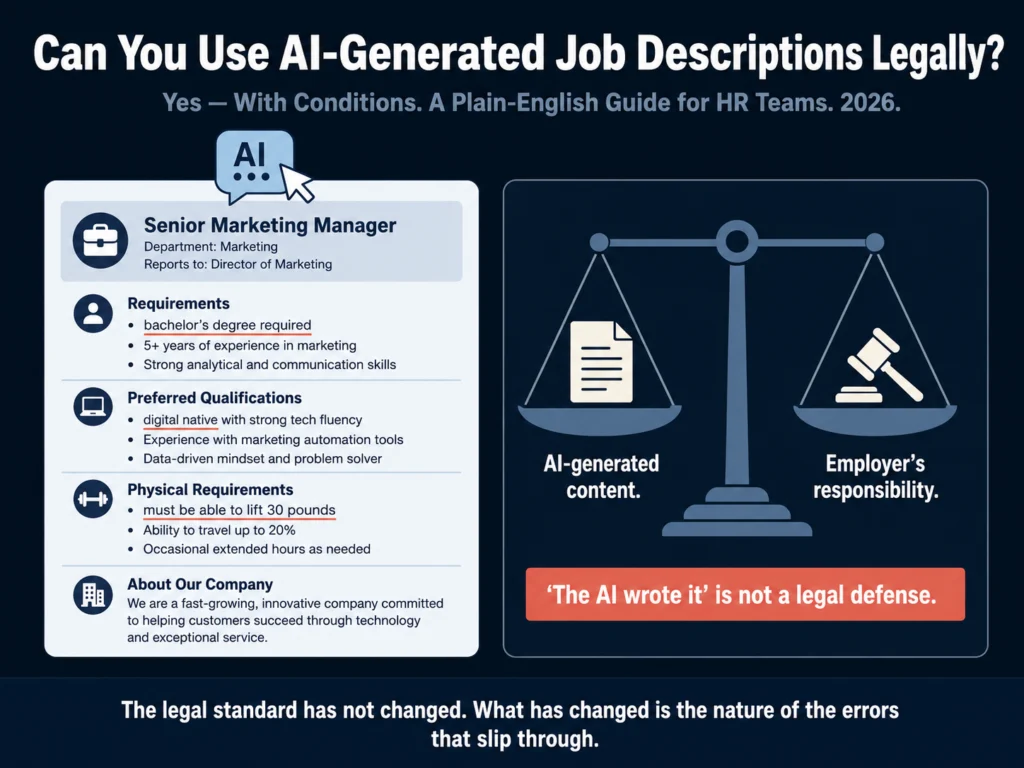
- Yes, using AI to write job descriptions is legal. There is no law prohibiting it.
- The content of those job descriptions is still your legal responsibility. “The AI wrote it” is not a defense.
- The three specific legal risks in AI-generated job descriptions: over-inflated requirements that create disparate impact, age-coded or disability-exclusionary language the AI reproduces from biased training data, and new state disclosure requirements you may not know apply to you.
- Illinois (January 2026), California (October 2025), Colorado (June 2026, enforcement uncertain), and New York City (since 2023) all have active laws that affect how AI can be used in employment contexts — with disclosure obligations that extend beyond just screening tools in some jurisdictions.
- Five things to check before posting any AI-generated job description: requirement necessity, language bias signals, credential inflation, disability screening language, and any explicit forward-looking promises the AI may have included.
- This article is informational. It is not legal advice. If your organization is navigating a specific compliance matter, consult qualified employment counsel.
The question HR teams most often ask about AI-generated job descriptions is whether they are allowed to use them.
The short answer is yes. No federal law and no state law in the United States currently prohibits using AI to draft a job description.
The more useful question is different: what legal obligations does a job description carry, and does the fact that AI wrote it change your liability for what it says?
The answer to that question is clearly no. The content of a job description — every requirement, every qualification, every promise — is the employer’s legal responsibility regardless of how it was produced.
The EEOC has been explicit on this point: employers using software, algorithms, or AI as part of a hiring process face the same anti-discrimination obligations as employers using purely human-driven processes.
What changes when AI writes a job description is not the legal standard. What changes is the nature of the errors that slip through.
Human-written job descriptions tend to fail in ways that reflect individual bias — the hiring manager who lists requirements they prefer in a candidate rather than requirements the job actually demands.
AI-generated job descriptions fail in different, less visible ways: they reproduce language patterns from training data that correlate with discrimination without any human intending it, and they include hallucinated or inflated requirements that can create disparate impact at scale.
This guide covers what the law actually requires of job description content, where AI-specific risks emerge, which states have active obligations HR teams need to understand, and the practical compliance steps for any HR team using AI to draft hiring documents.
- What the Law Requires of Job Description Content
- The Three Legal Risks Specific to AI-Generated Job Descriptions
- Five Checks Before Posting Any AI-Generated Job Description
- The Disclosure Question: Do You Have to Tell Candidates?
- What Reduced Federal Enforcement Means for HR Teams
- Related Reading
- Frequently Asked Questions
- Conclusion
What the Law Requires of Job Description Content
Job descriptions carry legal weight in three distinct ways.
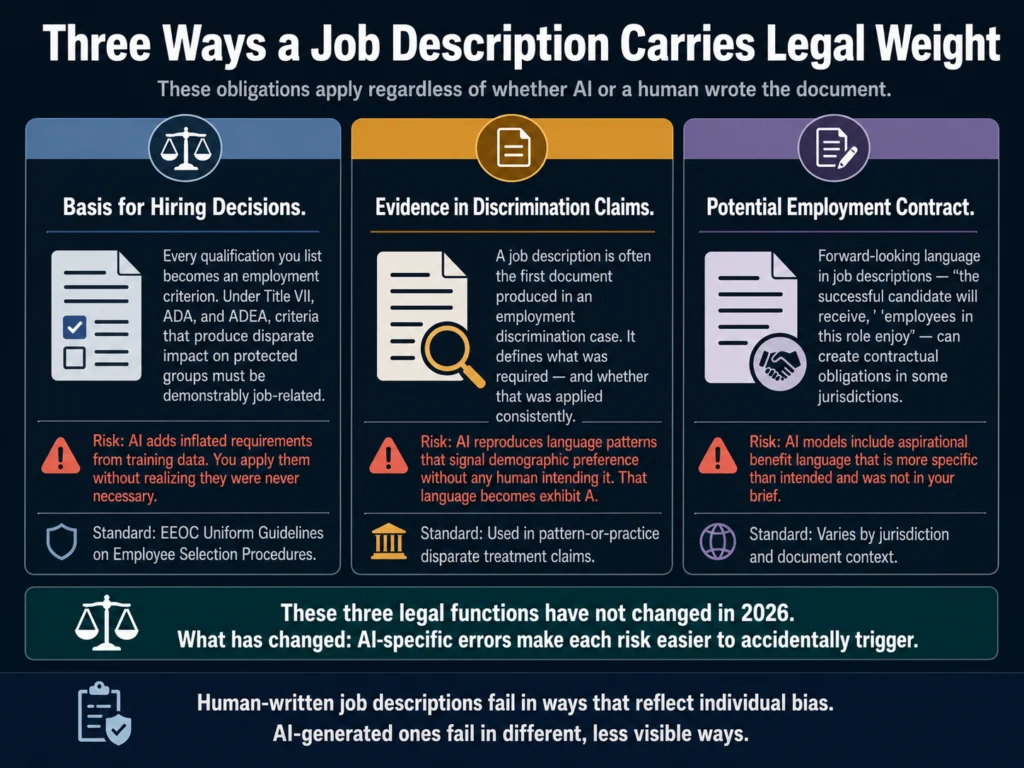
As the basis for hire decisions. If your job description lists qualifications and you hire or reject candidates based on those qualifications, you are making employment decisions on the basis of those criteria.
Under Title VII of the Civil Rights Act, the ADA, and the ADEA, employment criteria that produce a disparate impact on protected groups must be demonstrably related to actual job performance.
As evidence in discrimination claims. A job description is often the first document produced in an employment discrimination case.
If a rejected candidate challenges a hiring decision, the job description defines what qualifications were required and whether those requirements were applied consistently.
Language in a job description that signals preference for a demographic group — even unintentionally — can become evidence of discriminatory intent.
As a potential employment contract. In some jurisdictions and circumstances, language in a job description that makes forward-looking promises (“the successful candidate will receive a salary of,” “employees in this role are eligible for”) can create contractual obligations.
AI models generating job descriptions sometimes include aspirational or descriptive language in benefit sections that is more specific than intended.
The underlying legal framework has not changed in 2026.
What has changed is the regulatory environment’s recognition that AI tools are now involved in the production of hiring documents at scale — and the growing body of state law addressing that involvement.
The Three Legal Risks Specific to AI-Generated Job Descriptions
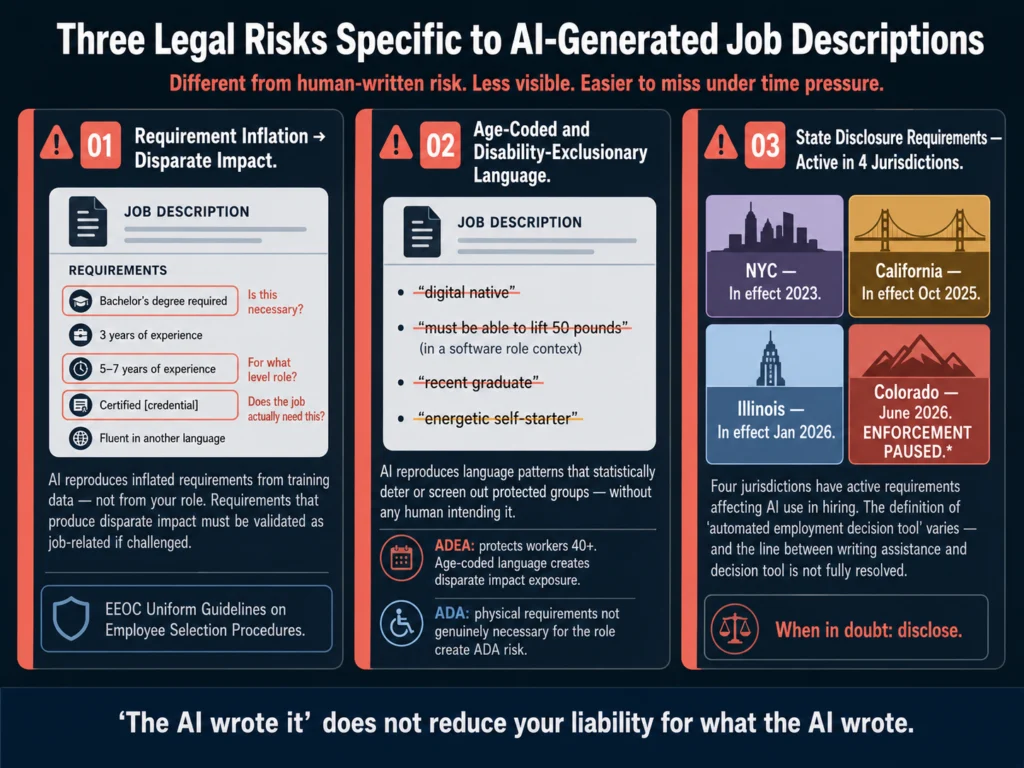
Risk 1: Requirement Inflation and Disparate Impact
AI models trained on large corpora of job descriptions learn to reproduce what “a job description” looks like.
What that training data reflects, overwhelmingly, is years of posted positions with over-inflated requirements — degree requirements for roles that do not need them, years-of-experience thresholds that exceed what the work actually demands, credential lists that have accumulated through iteration rather than deliberate design.
When an AI generates a new job description, it reproduces those patterns. The practical result is job descriptions that look credible but contain requirements that are not genuinely job-related.
Under the EEOC’s Uniform Guidelines on Employee Selection Procedures, selection criteria that produce disparate impact on protected groups must be validated as job-related if challenged.
A requirement that was added by an AI because it appeared in similar postings — not because the job actually demands it — is difficult to defend.
The specific patterns to watch for in AI-generated requirements:
Degree requirements where none is necessary. AI models frequently default to “bachelor’s degree required” or “advanced degree preferred” because these appear in the majority of similar postings in their training data.
For roles that do not genuinely require a degree, this language creates a disparate impact on candidates from certain racial and socioeconomic backgrounds. It also now creates risk under some state skills-based hiring initiatives.
Years-of-experience inflation. An entry-level analyst role should not require five to seven years of experience.
AI models sometimes generate inflated experience requirements because they mirror mid-level postings for similar titles in their training data.
Years-of-experience requirements above what the role genuinely demands can function as age discrimination by excluding younger workers from roles that do not require that much experience — or, at the higher end of a career, serving as a pretext for screening out older candidates.
Credential stacking. AI sometimes adds professional certifications, licenses, or technical credentials that appear frequently in similar postings but are not necessary for the specific role being hired.
Each unnecessary credential narrows the candidate pool in ways that may not be uniformly distributed across protected groups.
Risk 2: Age-Coded and Disability-Exclusionary Language
AI models reproduce language patterns that signal demographic preferences even when those signals are not explicit.
Two categories require specific attention.
Age-coded language refers to phrases that statistically correlate with either favoring younger candidates or disadvantaging older ones.
Research on job description language patterns has identified terms like “digital native,” “recent graduate,” “fresh perspective,” “energetic,” and “tech-savvy” as disproportionately deterring older applicants.
The inverse problem also exists: phrases like “seasoned professional” or “wealth of experience” may function as coded preferences for older workers that could be used to exclude younger ones.
The Age Discrimination in Employment Act (ADEA) protects workers 40 and older.
Language that signals age preference does not need to be explicit to create legal exposure — a pattern of age-coded job descriptions combined with a documented outcome of hiring disproportionately fewer candidates over 40 is the kind of evidence that supports a disparate impact claim.
Disability-exclusionary language is more nuanced. The ADA prohibits excluding candidates with disabilities from consideration unless the disability is directly relevant to a genuine occupational requirement.
An AI-generated job description that lists “must be able to lift 50 pounds” for a software engineering role, or “requires excellent vision” for a data analyst position, creates ADA compliance risk if those requirements are not genuinely necessary for the job.
The EEOC’s technical guidance on AI and the ADA notes specifically that AI tools can screen out individuals because of disability-related traits — and employers are responsible for that outcome even when the screening occurred through an algorithm rather than a human decision.
That principle applies to the language in a job description as well as to screening tool outputs.
Risk 3: State Disclosure Requirements
The most significant regulatory shift affecting AI use in job descriptions in 2026 is the emergence of state disclosure requirements.
These vary significantly by jurisdiction and are evolving quickly.
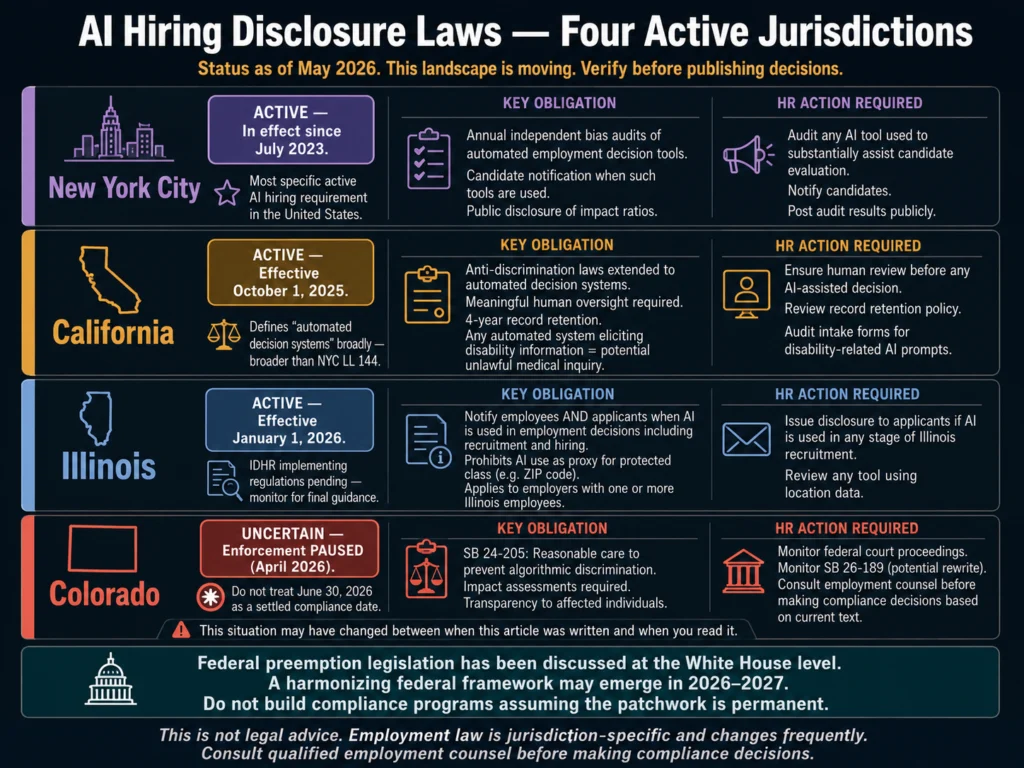
Illinois (effective January 1, 2026).
House Bill 3773 amended the Illinois Human Rights Act to require employers to notify both employees and applicants when AI is used in employment-related decisions — including recruitment, hiring, promotion, discipline, and any use that could affect the terms or conditions of employment.
The law applies to employers with one or more employees in Illinois. It also prohibits using AI in ways that discriminate based on protected characteristics, including using zip codes as a proxy for protected classes.
The Illinois Department of Human Rights is finalizing implementing regulations; employers should monitor IDHR guidance and review compliance with employment counsel.
California (effective October 1, 2025).
The California Civil Rights Council’s regulations extend the state’s anti-discrimination laws explicitly to automated decision systems.
The regulations require meaningful human oversight of any automated system used in employment, require employers to maintain records for four years, and prohibit automated systems that discriminate based on protected traits.
The regulations also clarify that any automated system that elicits information about disability may constitute an unlawful medical inquiry — relevant to how some AI tools prompt for candidate information.
Colorado (effective June 30, 2026, enforcement status uncertain).
Senate Bill 24-205, the Colorado AI Act, requires employers using high-risk AI systems to use “reasonable care” to prevent algorithmic discrimination, conduct impact assessments, and provide transparency to affected individuals.
As of April 2026, a federal court has paused enforcement during ongoing litigation — meaning the law’s effective date remains on the books but compliance obligations are currently frozen.
The Colorado legislature is also considering SB 26-189, which would substantially rewrite the statute’s framework before it takes effect.
Employers in Colorado should not treat June 30, 2026 as a settled compliance deadline.
Monitor developments and consult employment counsel before making compliance decisions based on this law’s current text.
New York City (in effect since July 2023).
Local Law 144 remains the most specific active AI hiring requirement in the United States.
It requires annual independent bias audits of automated employment decision tools and public disclosure of impact ratios.
It requires that candidates be notified when such tools are used. Unlike some other state laws, NYC LL 144 has been actively enforced.
As of spring 2026, employment lawyers tracking this space describe the landscape as a “patchwork” of state and local requirements with no federal law providing a harmonizing framework, though federal preemption legislation has been discussed at the White House level and may emerge in 2026 or 2027.
Organizations operating across multiple states face the most complex compliance picture.
Disclosure is a separate question from content compliance.
For most HR teams, the immediate compliance priority is the content of the job description: the requirements, the language, the accuracy.
Disclosure requirements vary by jurisdiction and apply most clearly to automated decision-making tools rather than to AI writing assistants.
However, in Illinois and potentially under California’s broader definitions, the line between “drafting assistance” and “employment decision tool” is not fully resolved. When in doubt, disclose.
Five Checks Before Posting Any AI-Generated Job Description
These are not a legal audit. They are the minimum editorial review that every AI-generated job description should go through before it is posted.
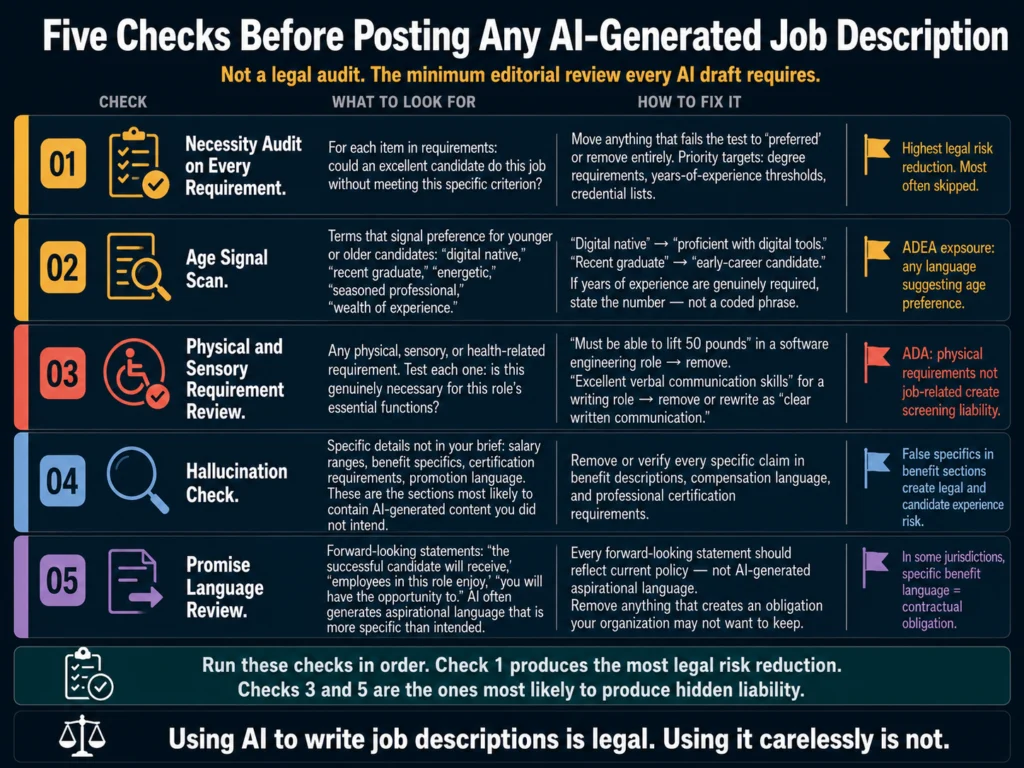
1. Necessity audit on every requirement.
For each item in the requirements section, ask: if a candidate could do this job excellently without meeting this requirement, should it be on the list?
Move any such item to “preferred” or remove it entirely. Pay particular attention to degree requirements, years-of-experience thresholds, and professional credentials.
2. Age signal scan.
Read the description looking specifically for terms that signal a preference for younger or older candidates. Remove or replace any that appear.
“Digital native” becomes “proficient with digital tools.” “Recent graduate” becomes “early-career candidate.” “Seasoned professional” should not appear unless the role genuinely requires extensive experience — and if it does, the years-of-experience requirement should be specific.
3. Disability and physical requirement review.
Every physical or sensory requirement in a job description should pass one test: is this genuinely necessary for the role?
“Must be able to commute to our New York office” for an on-site role is legitimate.
“Must possess excellent verbal communication skills” for a written content creation role may screen out candidates with speech disabilities without serving the role’s actual requirements.
If you would not require it of a candidate with a disability who could perform the job’s essential functions in another way, it should not be stated as a requirement.
4. Hallucination check.
AI models occasionally generate specific details (salary ranges, benefit terms, certification requirements) that are not accurate for your organization.
Review the description for any specific claims the AI made that were not in your brief. Pay particular attention to benefit descriptions, promotion language, and any forward-looking statements about career growth.
These are the sections most likely to contain hallucinated content that your legal team would not want in a posted document.
5. Promise language review.
Job descriptions that say “the successful candidate will receive” or “employees in this role enjoy” may create obligations.
Review any sentence that makes a forward-looking promise about compensation, benefits, or working conditions.
These statements should reflect your actual current policy, not AI-generated aspirational language.
The Disclosure Question: Do You Have to Tell Candidates?
Currently, there is no federal law requiring employers to disclose that AI was used to write a job description.
The disclosure requirements that do exist — in New York City, California, Illinois, and Colorado — apply most clearly to automated tools that make employment decisions, which is a different legal category from tools that help humans draft documents.
That said, this distinction is not fully resolved in all jurisdictions. Illinois’s language is broad. California’s regulations define automated decision systems expansively.
If your organization operates in those states and uses AI tools as part of the hiring process, a conservative approach is to include a brief disclosure in your application materials noting that AI tools are used in hiring-related processes and that all hiring decisions are made by human employees.
Whether or not disclosure is legally required, it may be strategically sensible.
Research consistently shows that candidates who understand how a process works and feel it was applied fairly are more likely to accept offers and remain engaged through onboarding — regardless of whether AI was involved.
For more on the disclosure requirement specifically, read: How to Disclose AI Use in Your Hiring Process to Candidates
What Reduced Federal Enforcement Means for HR Teams
The Trump administration’s April 2025 executive order directing federal agencies to reduce pursuit of disparate impact enforcement created some confusion about whether EEOC AI enforcement had effectively ended. The practical answer for HR teams is: not materially.
Private plaintiffs can still bring disparate impact claims. State attorneys general are actively pursuing cases.
The Mobley v. Workday class action, discussed in depth in AI Bias in Hiring — What HR Teams Need to Know, proceeds on statutory grounds unaffected by the executive order.
The source of legal risk has shifted from federal enforcement to private litigation and state-level enforcement. For HR teams, this means the risk has not decreased. It has changed shape.
Related Reading
- Best AI Tools for Writing Job Descriptions
- How to Write 10 Job Descriptions in One Day Using AI
- AI Tools for Resume Screening — What Actually Works
- AI Bias in Hiring — What HR Teams Need to Know
- How to Disclose AI Use in Your Hiring Process to Candidates
- How to Audit AI Job Posts for Bias Before Publishing
- AI Ethics and Compliance in Hiring — The Complete Guide
Frequently Asked Questions
No. As of May 2026, no federal law and no state law in the United States explicitly prohibits using AI to draft job description content. The laws that apply to AI in hiring — including the new state regulations in California, Illinois, and Colorado — focus primarily on automated decision-making tools that evaluate or rank candidates. A tool used to draft a job posting that a human then reviews and approves is generally treated differently from a tool that makes candidate advancement decisions autonomously. However, if the AI tool also functions as part of a selection process or generates language that influences candidate screening, the legal analysis becomes more complex and jurisdiction-specific.
The Mobley v. Workday litigation, currently ongoing as of May 2026, is directly testing the question of vendor liability in AI hiring tools. A 2024 court ruling held that Workday could be treated as an “agent” of the employers who used its platform — potentially exposing both the vendor and the employer to liability. That ruling addressed screening tools, not drafting tools, but the principle may extend. More practically: for general-purpose AI writing tools (ChatGPT, Claude, Jasper), vendor liability for discriminatory content in AI-generated job descriptions has not been tested in litigation. Employment lawyers uniformly advise that employers should not assume the tool vendor will share any liability for discriminatory outcomes — the safest assumption is that liability rests with the employer.
Degree requirements that are not genuinely necessary for job performance can create disparate impact claims under Title VII. Research has consistently shown that blanket degree requirements disproportionately exclude Black, Hispanic, and first-generation applicants from roles where the degree is not actually necessary. When AI generates a degree requirement because it appeared in similar job postings — rather than because your specific role actually requires a degree — you have inherited a potentially discriminatory criterion from biased training data. If that criterion is challenged, you must demonstrate that the degree requirement is genuinely job-related and consistent with business necessity. Removing unnecessary degree requirements is both legally defensible and expands your candidate pool.
New York City Local Law 144’s disclosure requirement applies specifically to “automated employment decision tools” — tools that use machine learning, statistical modeling, or AI to substantially assist or replace discretionary decision-making in screening or evaluating candidates. A general-purpose AI writing tool used to draft a job description, where a human makes all subsequent hiring decisions, is not clearly covered by that definition. However, if your organization also uses AI-powered screening tools, video interview scoring, or other automated decision tools as part of the same process, the broader disclosure requirement likely applies to the overall process. The safer position for any organization using AI tools in hiring in New York City is to include a disclosure and consult employment counsel about the specific tools in use.
The requirements audit — specifically, whether every listed qualification is genuinely necessary for the job. This is the check that produces the most significant legal risk reduction and the one most likely to be skipped under time pressure. For each requirement, apply this test: if an excellent candidate met every other requirement on the list but not this one, would you genuinely reject them? If no, the requirement should be removed or moved to “preferred.” This exercise catches credential inflation, unnecessary degree requirements, and experience thresholds that the AI reproduced from training data rather than derived from the actual role. It is also the check that most directly addresses EEOC concerns about AI-driven hiring criteria producing disparate impact.
Conclusion
Using AI to write job descriptions is legal. Using it carelessly is not.
The distinction matters because AI-generated job descriptions carry the same legal freight as human-written ones — and because the errors AI introduces are different in kind from the errors humans make.
Human writers bias toward the candidates they have in mind. AI models bias toward the patterns in their training data, which reflect years of real-world hiring with documented demographic disparities.
The compliance steps for AI-generated job descriptions are not technically complex.
Audit every requirement for genuine necessity. Remove age-coded language. Check physical and sensory requirements against what the role actually demands.
Review forward-looking language for unintended promises. Understand which disclosure requirements apply to your jurisdiction.
What is complex is the legal landscape itself, which is evolving faster than any single article can track.
The state-level patchwork of AI employment regulations in 2026 is expected to change significantly by 2027, potentially including federal preemption legislation.
Organizations that build compliance practices now — document review processes, requirements auditing, disclosure policies — are better positioned to adapt to whatever federal framework eventually emerges.
The legal and regulatory picture in this article reflects what the Ailovyu team has tracked across court filings, state regulatory actions, and law firm guidance through May 2026.
It is still moving — and the Colorado situation alone illustrates how quickly the picture can shift between when an article is written and when it is read.
We research and test AI tools so you can make informed decisions before spending money on them. Every review, comparison, and tutorial on this site is based on actual use, not vendor marketing.
Learn more on our About page.
Legal information in this article is sourced from EEOC technical guidance documents, published law firm analyses (Akerman LLP, Harris Beach Murtha, DarrowEverett LLP), and state regulatory texts. This article is for informational purposes only and does not constitute legal advice. Employment law is jurisdiction-specific and changes frequently. Consult qualified employment counsel before making compliance decisions. No affiliate relationships are disclosed in this article.