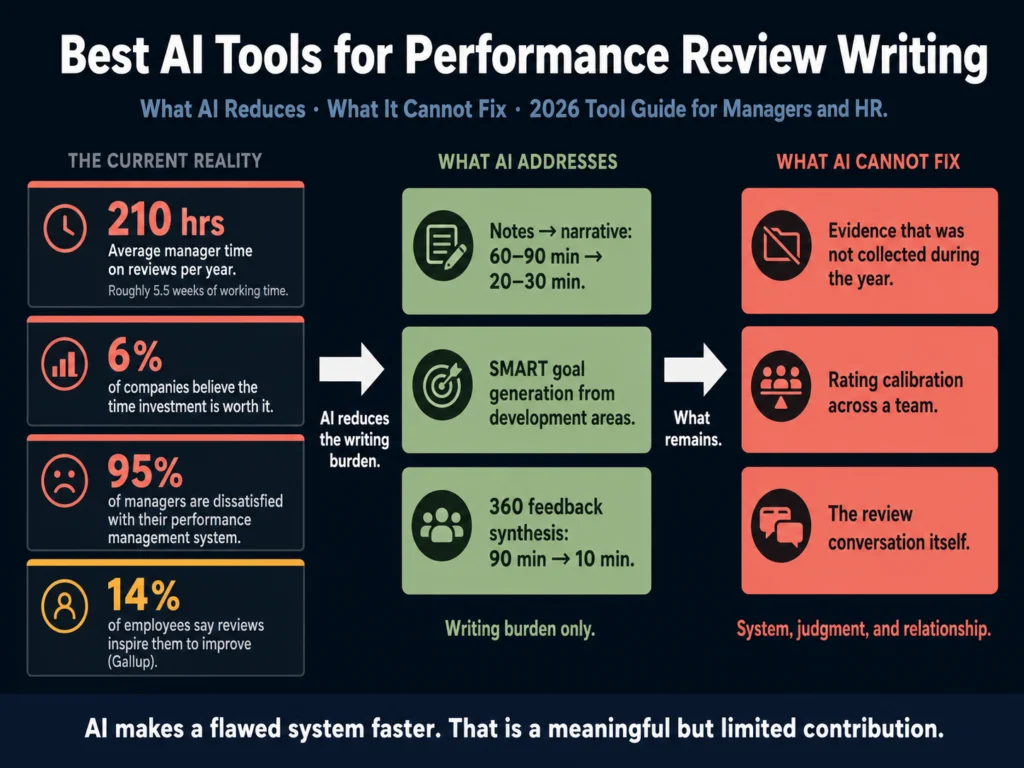
- Managers spend an average of 210 hours per year on performance review activities. AI meaningfully reduces the drafting time, but cannot fix the underlying system, the bias, or the conversation.
- 95% of managers are dissatisfied with their performance management systems. AI makes a flawed system faster, not better. The tools in this article address the writing burden, not the structural problem.
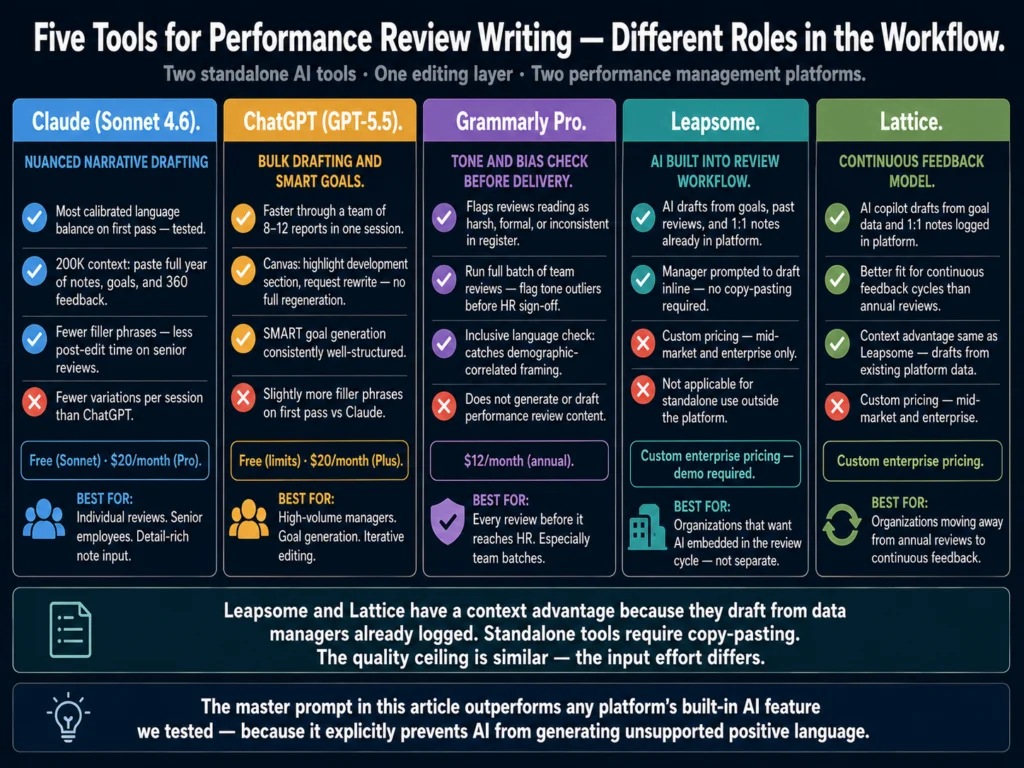
- Best for narrative drafting from notes: Claude (Sonnet 4.6) produces more nuanced, balanced review language than ChatGPT on the first pass. Both work with a structured prompt.
- Best for tone and bias-checking a draft: Grammarly Pro flags language that reads as vague, harsh, or inconsistent before the review reaches the employee.
- Best for full performance management with AI writing features: Leapsome and Lattice both include AI writing assistance within their review cycles. Worth evaluating if you are also re-platforming your performance management process.
- The most common AI mistake in performance reviews: generating positive-sounding language that contains no evidence. A review that says “consistently demonstrates strong leadership” without a single example is legally weak and developmentally useless.
The math on performance reviews is grim.
Managers spend an average of 210 hours per year on performance review activities, according to 2026 benchmarking data, roughly five and a half weeks of working time per year, every year, on a process that only 6% of companies believe is worth the time investment.
95% of managers express dissatisfaction with their performance management systems, according to PerformYard’s 2025 State of Performance Management Report.
Only 14% of employees say reviews inspire them to improve, according to Gallup. 90% of HR leaders admit that performance reviews fail to accurately reflect employee contributions, a finding sourced to Corporate Executive Bord research.
These numbers describe a process that consumes enormous management bandwidth while producing almost no one who thinks it works.
AI does not fix this problem. It makes the writing portion of it faster.
That is a meaningful but limited contribution — the difference between spending 210 hours and spending 140 hours on a process that still produces documentation neither managers nor employees find valuable.
The tools in this article are worth using. But they are worth using with a clear-eyed view of what they can and cannot address.
- What Makes Performance Review Writing Different
- What AI Handles Well in Performance Review Writing
- What AI Cannot Do in Performance Reviews
- The Master Prompt for Performance Review Narrative Drafting
- Tool Recommendations
- Claude (Sonnet 4.6) — Best for Nuanced Narrative Drafting
- ChatGPT (GPT-5.5 Instant) — Best for Bulk Drafting and Goal Generation
- Grammarly Pro — Best for Tone and Bias Checking Before Delivery
- Leapsome — Best Full-Platform Option with AI Writing Assistance
- Lattice — Best for Organizations Moving Toward Continuous Feedback
- A Note on Copy.ai for Performance Reviews
- Legal Consideration: What HR Should Check Before Finalizing
- Related Reading
- Frequently Asked Questions
- Conclusion
What Makes Performance Review Writing Different
Performance review writing differs from every other HR writing task in this cluster in four specific ways that affect how AI tools should be applied.
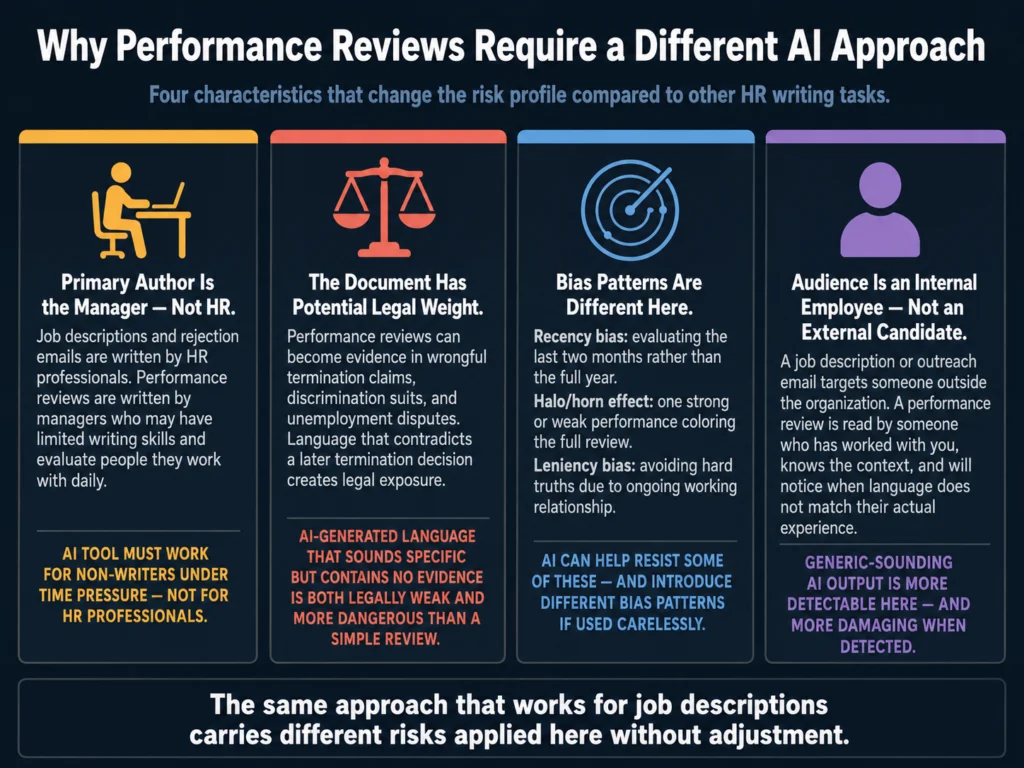
The primary author is the manager, not HR.
Unlike job descriptions or rejection emails, performance reviews are written by the people being evaluated and the managers evaluating them.
AI tools for performance review writing must work for managers who may not have strong writing skills and who are evaluating people they work with every day — not for HR professionals writing on behalf of the organization.
The document has potential legal weight.
Performance reviews can become evidence in wrongful termination claims, discrimination suits, and unemployment disputes.
Language that appears to contradict a later termination decision, or that fails to document performance issues that were used to justify a dismissal, creates legal exposure.
AI-generated performance reviews that are approved without legal-language review carry this risk.
The bias patterns are distinct.
Performance review writing is susceptible to biases that do not apply to other HR documents: recency bias (evaluating the last two months rather than the full year), halo and horn effects (one strong or weak performance coloring the entire evaluation), and leniency bias (avoiding hard truths because the manager has an ongoing working relationship with the person).
AI can help structure reviews to resist some of these biases — and can introduce new ones if used carelessly.
The audience is an internal employee, not an external candidate.
This changes the tone, the legal obligations, and the development purpose.
A performance review that is motivating and specific to the employee’s actual contributions is a different document from a review that reads as generic and defensive.
What AI Handles Well in Performance Review Writing
Converting Notes to Narratives
The most practical AI use case for performance reviews is note-to-narrative conversion.
A manager who keeps running notes on a direct report throughout the year — accomplishments, feedback conversations, project outcomes, missed targets — has the evidence they need for a strong review.
What they often lack is the time and writing skill to turn those notes into coherent, specific, balanced narrative text.
AI handles this conversion well. A prompt that includes a chronological list of 10 to 15 specific observations from the year, plus the employee’s role and level, produces a first-draft narrative that is significantly better than what most managers write from memory under year-end time pressure.
Ensuring Balance
Many managers write reviews that are either uniformly positive (avoiding difficult truths) or uniformly negative (failing to acknowledge genuine contributions).
A well-structured AI prompt that explicitly requests both strengths and development areas produces more balanced output than most managers generate under time pressure.
The balance is structural — the prompt forces inclusion of both — not evaluative. The AI does not assess whether the observations are accurate.
Generating Development Goals
The SMART goal framework (Specific, Measurable, Achievable, Relevant, Time-bound) is well within AI’s capability to apply.
Given an employee’s development area and role context, ChatGPT and Claude generate SMART goals that are better structured than most managers produce manually.
The goals still require manager review for accuracy and relevance — but the structural quality is consistently better.
Summarizing 360 Feedback
In organizations that collect peer feedback, synthesizing 6 to 12 written peer responses into a coherent theme summary is a task that can take a manager 60 to 90 minutes manually.
AI can reduce this to 10 minutes. The input is the raw peer feedback; the output is a structured thematic summary identifying 3 to 4 consistent observations.
Quality depends heavily on the quality of the peer feedback — AI cannot create insight from responses that lack specificity.
Language Calibration Across a Team
A manager evaluating 8 direct reports should use consistent language intensity across the team.
“Exceptional” for one person and “solid” for another conveys a calibration difference that affects how employees perceive their relative standing.
AI can be prompted to review a batch of narratives and flag inconsistencies in language intensity across reports.
What AI Cannot Do in Performance Reviews
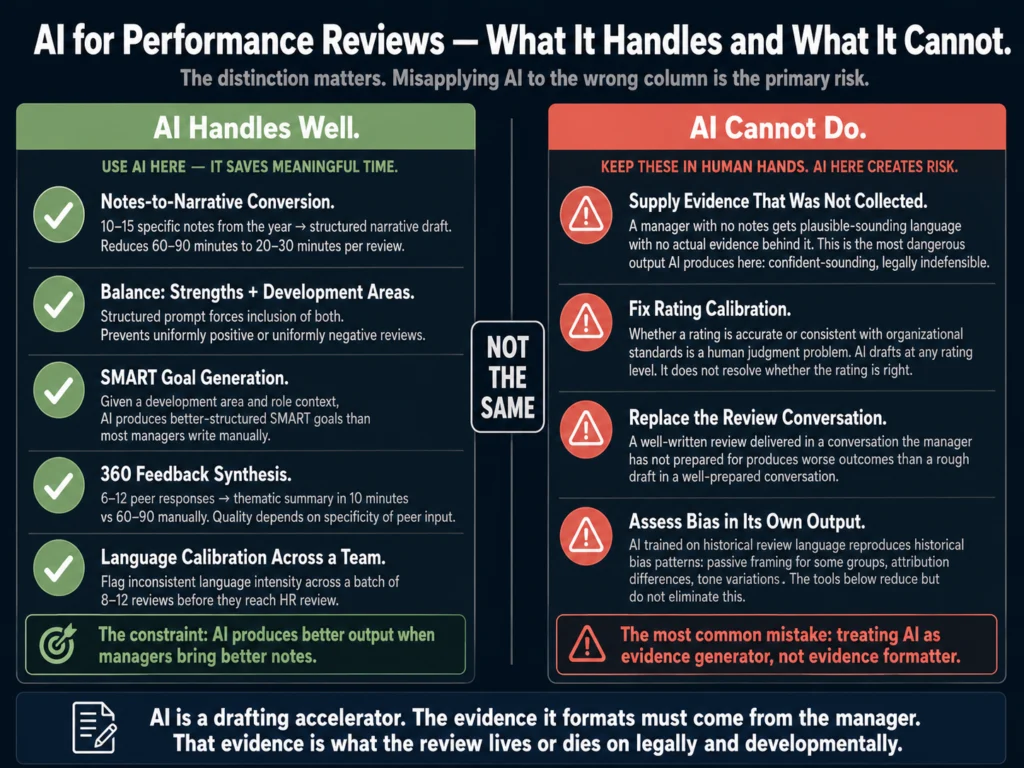
AI cannot supply evidence that was not collected.
A manager who did not take notes throughout the year cannot use AI to generate specific examples of an employee’s performance.
AI will produce plausible-sounding language — “consistently demonstrated strong problem-solving skills” — that contains no actual evidence.
This is the most dangerous output AI produces in the performance review context: confident-sounding, legally indefensible language that an employee can reasonably challenge.
AI cannot fix rating calibration.
The gap between what a manager rates an employee and what HR or a review committee determines is appropriate calibration is a human judgment problem.
AI can help draft language at any rating level but does not resolve the underlying question of whether a rating is accurate or consistent with organizational standards.
AI cannot replace the review conversation.
The written review is a record of a conversation that should have already happened — or at minimum, a preview of the conversation that will happen when the manager delivers it.
A well-written AI-assisted review delivered in a conversation the manager has not prepared for produces a worse outcome than a rough draft delivered in a well-prepared conversation.
AI cannot assess for bias in its own outputs.
AI models trained on historical performance review language reproduce the bias patterns embedded in that language — more passive framing for women’s contributions, attribution differences across demographic groups, tone differences that correlate with protected characteristics.
The tools below help with some of this, but none of them eliminate it.
That balance is worth internalizing before deploying any AI tool in a review cycle.
The Master Prompt for Performance Review Narrative Drafting
This prompt converts manager notes into a structured performance review narrative.
Managers fill in the bracketed variables; AI produces the draft.
You are helping a manager write a performance review narrative for a
direct report. Use only the information provided — do not add examples,
accomplishments, or observations that are not in the notes below.

Employee name: [NAME]
Role and level: [TITLE, LEVEL]
Review period: [e.g., January–December 2026]
Manager name: [YOUR NAME]

Performance notes from the review period (list specific observations,
accomplishments, feedback conversations, and outcomes):
[PASTE NOTES HERE — as many specific details as possible]

Write a structured performance narrative with four sections:

SECTION 1 — OVERALL PERFORMANCE SUMMARY (2–3 sentences)
Summarize the employee's overall contribution during the review period.
Reflect the weight of the evidence in tone — do not inflate positively
or negatively beyond what the notes support.

SECTION 2 — STRENGTHS (3–5 observations)
Write in specific, evidence-based language. Each strength should
reference at least one observation from the notes. Avoid vague phrases
like "strong communicator" or "team player" without a specific example.

SECTION 3 — DEVELOPMENT AREAS (2–3 areas)
Write constructively and specifically. Reference the evidence from
the notes. Frame as what the employee should develop, not what they
did wrong.

SECTION 4 — GOALS FOR NEXT REVIEW PERIOD (2–3 goals)
Write in SMART format: specific, measurable, achievable, relevant,
time-bound. Goals should connect directly to the development areas
in Section 3.

Tone: direct and professional. Avoid corporate filler phrases.
Do not use passive voice to obscure accountability ("errors were
made" instead of "made errors in X"). Do not use language that
implies protected characteristics.This prompt produces better first drafts than any performance management platform’s built-in AI writing features we tested, specifically because the constraint “use only the information provided” prevents AI from generating unsupported positive language.
Tool Recommendations
Claude (Sonnet 4.6) — Best for Nuanced Narrative Drafting
In testing performance review narrative drafts across both Claude and ChatGPT, Claude produces more calibrated language on the first pass — better balance between recognition and development feedback, fewer filler phrases, tighter sentence structure.
For managers evaluating senior employees where language nuance matters significantly, Claude’s output requires less editing.
The 200K context window allows pasting a full year of meeting notes, 360 feedback responses, and goal documentation into a single session.
Claude maintains coherence across a longer context than ChatGPT, which matters when the input is dense.
Best for: Individual narrative drafts, senior employee reviews, cases where a manager has detailed notes but limited writing time.
Pricing: Free (Sonnet via Claude.ai) or $20/month (Pro, Opus 4.7 access).
ChatGPT (GPT-5.5 Instant) — Best for Bulk Drafting and Goal Generation
ChatGPT handles performance review drafting competently and is faster for managers running through a team of 8 to 12 reports in a single session.
It generates SMART goals consistently and produces good structural output when given clear inputs.
The Canvas workspace is useful for performance reviews specifically: you can generate a draft, highlight a development area section, and ask for a rewrite without regenerating the whole document.
Best for: High-volume managers reviewing large teams, SMART goal generation, iterative editing through Canvas.
Pricing: Free (GPT-5.5 Instant) or $20/month (Plus — removes usage limits and adds GPT-5.5 Thinking, which handles longer note inputs and maintains coherence across large review batches better than the free tier).
Grammarly Pro — Best for Tone and Bias Checking Before Delivery
Performance review language should be direct, evidence-based, and consistent.
Grammarly’s tone detector flags when a review reads as harsh, overly formal, or inconsistent in register — signals that often indicate a manager wrote a section under frustration rather than reflection.
The more specific use case: run a manager’s full set of 8 to 12 reviews through Grammarly as a batch before HR review.
Flag any review where the tone reads as significantly more negative or more formal than the others.
That inconsistency is worth a conversation before the review reaches the employee.
→ Grammarly Pro’s tone detection is particularly valuable for catching language inconsistencies across a team’s performance reviews before HR sign-off.
Leapsome — Best Full-Platform Option with AI Writing Assistance
Leapsome is a people management platform covering performance reviews, goal-setting, engagement surveys, and learning.
Its AI writing assistant is built into the review workflow — managers are prompted to draft review narratives inline, with AI suggestions surfaced in context.
The integration advantage over standalone AI tools is significant: Leapsome’s AI can reference the employee’s logged goals, past reviews, and 1:1 notes from within the same platform.
This produces more relevant drafts than a generic AI model working from copy-pasted notes.
Pricing: Custom pricing — Leapsome does not publish rates. Mid-market and enterprise focused. Request a demo.
Best for: Organizations that want AI writing assistance embedded in their performance management workflow rather than managing a separate AI tool.
Lattice — Best for Organizations Moving Toward Continuous Feedback
Lattice’s AI copilot (introduced in late 2025) assists managers with drafting review narratives from goal data and 1:1 notes logged within the platform.
Like Leapsome, the context advantage is meaningful — the AI drafts from data the manager has already logged rather than from copy-pasted inputs.
Lattice’s strength is in continuous feedback workflows rather than annual review cycles.
For organizations shifting away from annual reviews — 82% of employees reported their company gave annual reviews in 2016, a number that dropped to just 54% by 2019, according to ClearCompany data — Lattice’s continuous feedback model is a better structural fit.
Pricing: Custom pricing. Mid-market and enterprise.
Best for: Organizations replacing annual review cycles with continuous feedback models.
A Note on Copy.ai for Performance Reviews
Copy.ai’s template library does not include dedicated performance review templates, but its workflow automation features allow building a performance review template once and generating drafts from structured manager inputs.
For HR teams administering review cycles across a large organization where manager writing quality is highly variable, a standardized Copy.ai workflow can reduce the variance in review quality across a team.
→ Copy.ai’s free plan (2,000 words/month) is enough to test one performance review template workflow before committing to the paid tier.
Legal Consideration: What HR Should Check Before Finalizing
Performance reviews sometimes become evidence in employment disputes.
Before any AI-assisted review enters the employee’s permanent file, HR should verify four things.
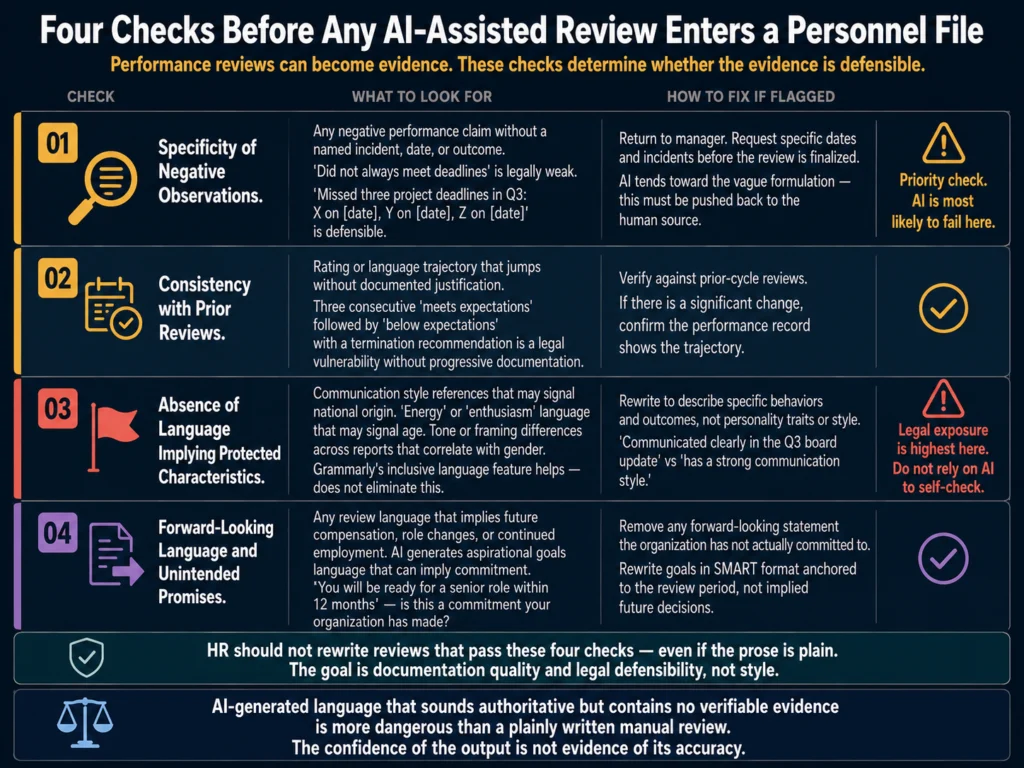
Specificity of negative observations.
A review that documents a performance issue vaguely (“did not always meet deadlines”) is weaker legal documentation than one that names the incidents: “missed three project deadlines in Q3: X on [date], Y on [date], Z on [date].”
AI tends toward the vague formulation. Push managers to provide specific dates and incidents in their notes before the AI drafts.
Consistency with prior reviews.
An employee who received “meets expectations” ratings for three consecutive years and then receives a “below expectations” rating with a termination recommendation three months later faces a more credible legal argument than one whose performance decline was documented progressively.
AI-assisted reviews that introduce a sudden change in language without accompanying evidence are legally weak.
Absence of language implying protected characteristics.
Review language that correlates with demographic characteristics — references to communication style that may signal national origin, language about “energy” or “enthusiasm” that may signal age, framing differences between male and female reports — should be caught in review.
Grammarly’s inclusive language features help but do not eliminate this risk.
Forward-looking language.
Review language that promises future compensation, role changes, or continued employment creates obligations.
AI sometimes generates aspirational forward-looking language in the goals section that was not in the manager’s notes.
Remove any forward-looking statement that your organization cannot or has not committed to.
Related Reading
- AI Bias in Hiring — What HR Teams Need to Know
- How to Write a 30-60-90 Day Onboarding Plan with AI
- How to Use AI for Performance Review Cycles — A Tutorial
- How to Build an AI Prompt Library for HR Teams
- AI for HR Communications and Documentation — The Complete Guide
Frequently Asked Questions
Technically, yes. Practically, the output is useless and legally risky. An AI-generated performance review that contains no specific evidence of actual performance — because the manager provided no notes — produces confident-sounding text that describes a generic employee rather than the person being reviewed. This kind of review is both developmentally meaningless for the employee and legally indefensible in a dispute. If an AI model produces a review that the manager cannot verify against specific observations from the year, that review should not be finalized. AI for performance reviews is a drafting accelerator, not a replacement for the evidence the manager was supposed to collect throughout the year.
No existing employment law prohibits using AI to assist with drafting performance review language. The legal obligations that apply to performance reviews — consistency, documentation specificity, freedom from discriminatory language — apply equally to AI-assisted and manually written reviews. The risk is not the tool; it is the output. AI-generated language that is vague, inconsistent with prior reviews, or contains demographic-correlated framing creates the same legal exposure as manually written reviews with the same characteristics. HR should review AI-assisted performance reviews with the same scrutiny applied to any review before it enters a personnel file.
This is the most common scenario and the one where AI assistance produces the worst outcomes. A manager with no notes will prompt AI with vague inputs and receive vague outputs — language that sounds like a performance review but contains nothing specific. HR’s response should be to require that managers provide at least 5 to 8 specific, dated observations before submitting a review for drafting assistance. This requirement should be built into the review process itself, not retrofitted at the drafting stage. The best time to fix the evidence problem is through continuous documentation throughout the year — not in the 48 hours before reviews are due.
Partially. Recency bias — evaluating the last two months rather than the full year — is a function of what evidence the manager brings to the drafting process. If the manager’s notes are concentrated in Q4, the AI draft will reflect Q4. If the prompt explicitly requests quarterly observations (“provide 2–3 specific observations from each quarter”), the AI will structure the output to reflect the full year — but only if the manager has observations from each quarter to provide. The most effective recency bias mitigation is requiring managers to log observations at the end of each month or quarter, not hoping AI can reconstruct a full year from the last-minute notes they provide.
HR should function as the quality and consistency gate, not the drafting resource. When managers submit AI-assisted reviews, HR’s review should check for four things: specificity of evidence (are there named examples or just general statements?), consistency with the employee’s prior reviews (does the rating trajectory make sense?), language that could imply protected characteristics (demographic-correlated framing), and forward-looking promises the organization has not committed to. HR should not rewrite reviews that pass these checks — even if the writing style is plain or imperfect. The goal is documentation quality and legal defensibility, not prose quality.
Conclusion
The 210-hour-per-year manager time burden on performance reviews is not primarily a writing problem.
It is a system design problem, a documentation discipline problem, and an evidence collection problem.
AI tools address the writing portion — and they address it well, when managers bring adequate notes to the drafting process.
Used correctly, the workflow is straightforward: managers keep running notes throughout the year, paste those notes into the master prompt at review time, review the AI draft against the evidence, edit for accuracy and tone, run through Grammarly for a final tone check, and submit for HR review.
Total drafting time per review: 20 to 30 minutes rather than 60 to 90.
Used incorrectly (as a substitute for evidence collection, not an accelerator of it), AI produces reviews that are legally weak, developmentally useless, and likely to generate employee grievances when the confident language does not survive scrutiny.
The 95% manager dissatisfaction rate and the 6% organizational satisfaction rate with performance reviews reflect a process whose problems run deeper than the time it takes to write.
AI saves time on the writing. Everything else is still yours to fix.
The workflow and prompt in this article reflect what the Ailovyu team has found reduces drafting time without creating the false confidence that comes from AI-generated language that sounds specific but contains nothing verifiable.
We research and test AI tools so you can make informed decisions before spending money on them. Every review, comparison, and tutorial on this site is based on actual use, not vendor marketing.
Learn more on our About page.
Statistics sourced from BragBook Performance Review Statistics 2026, PerformYard 2025 State of Performance Management Report (via Speakwise 2026 analysis), Gallup “More Harm Than Good: The Truth About Performance Reviews,” Corporate Executive Board (CEB) performance management research, Confirm.com Performance Review Trends 2025–2026, ClearCompany performance management statistics, and People Managing People performance management statistics compilation. Affiliate links in this article earn a commission at no extra cost to you. Tool pricing verified May 2026 from vendor websites. This article is for informational purposes and does not constitute legal advice.