
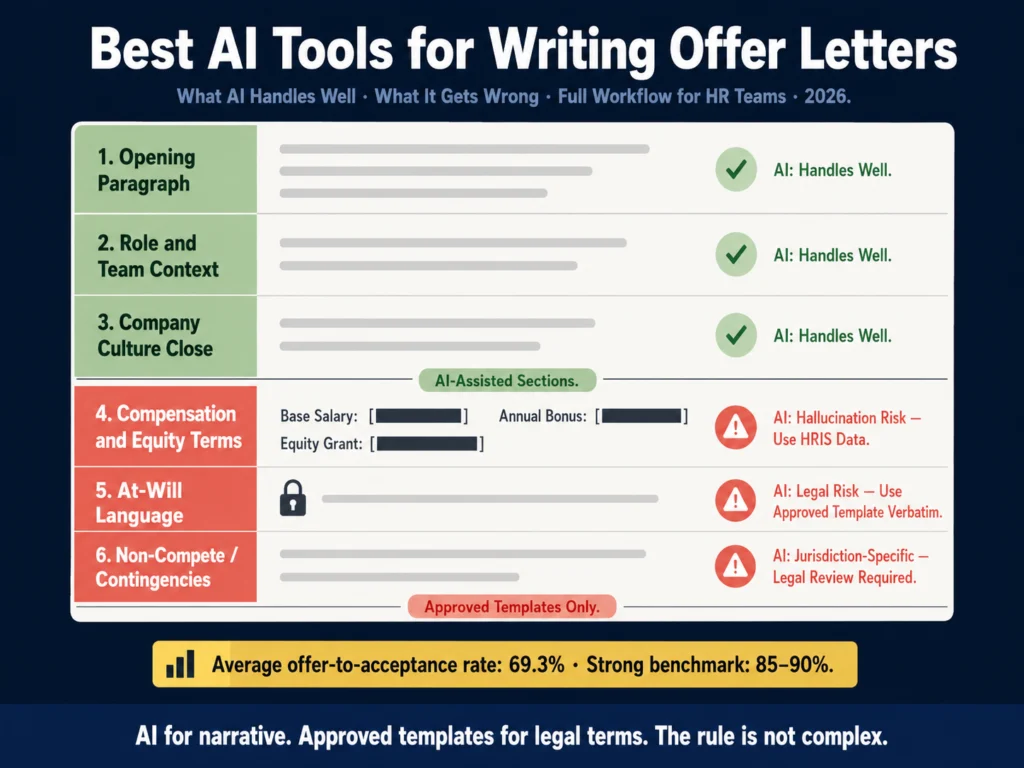
- The average offer-to-acceptance rate is 69.3%. A well-written, fast, and personalized offer letter is one of the few levers recruiters directly control at this stage of the funnel.
- AI is genuinely useful for the narrative sections of an offer letter — the opening, the role description, the team context, and the closing. These sections are where tone matters, and AI handles tone well.
- AI should never write the legal and financial terms alone. Compensation figures, equity terms, bonus structures, at-will language, and contingency clauses must come from verified legal templates, not AI generation.
- For drafting the narrative sections: Claude (Sonnet 4.6) produces the most natural-sounding offer letter language; ChatGPT (GPT-5.5 Instant) is faster and broader.
- For the full offer letter workflow — templates, approvals, e-signature, and tracking — Manatal and Greenhouse handle this end-to-end better than any standalone AI writing tool.
- Grammarly Pro is the right editing layer before an offer letter goes out. Tone accuracy on this document is non-negotiable.
The offer letter arrives at the end of a process that may have taken 6 to 10 weeks.
It is the document that converts everything that came before — sourcing, screening, interviewing, selling — into a signed commitment.
And the average offer-to-acceptance rate is 69.3%, according to NACE benchmarking data, meaning nearly 1 in 3 offers extended is declined.
A strong offer acceptance rate benchmarks at 85 to 90%. The gap between the average and the benchmark represents candidates who were interested enough to complete your entire hiring process and still said no.
Some declines are about compensation or competing offers that no letter can fix. Others are about the letter itself — it arrived too slowly, read too formally, or failed to remind the candidate why they wanted this role in the first place.
AI tools make offer letters faster to produce and, when used correctly, easier to personalize.
But they introduce specific risks that do not exist in other HR writing tasks, because offer letters contain legal language that, if generated incorrectly, creates obligations your company did not intend to make.
This article separates what AI handles well from what it handles dangerously, and recommends specific tools for each part of the process.
- The Two Categories of Tools You Need to Understand
- What AI Handles Well in Offer Letter Writing
- What AI Gets Wrong in Offer Letters
- Writing Tool Recommendations
- Offer Management Platforms That Include AI Features
- A Prompt Template for Offer Letter Narrative Sections
- The Speed Factor: Why Timing Matters as Much as Content
- Related Reading
- Frequently Asked Questions
- Conclusion
The Two Categories of Tools You Need to Understand
Before reviewing specific products, the distinction between two tool categories matters for offer letters specifically.
Writing tools (ChatGPT, Claude, Jasper, Grammarly) generate or refine the language in your offer letter.
They handle narrative sections well: the opening paragraph, the role description, the team context, the company culture close.
They should not be trusted with the structured legal and financial sections without significant human oversight.
Offer management platforms (Manatal, Greenhouse, Workable, BambooHR, and Workday) handle the full operational workflow: pulling compensation data from your HRIS, applying approved legal templates, routing for approval, sending for e-signature, and tracking acceptance.
These platforms ensure the legally consequential sections of an offer letter are sourced from verified templates rather than generated fresh each time.
The best offer letter workflow uses both: a writing tool to craft the narrative sections that actually persuade a candidate, and an offer management platform to assemble the final document with legal terms sourced from approved templates.
What AI Handles Well in Offer Letter Writing
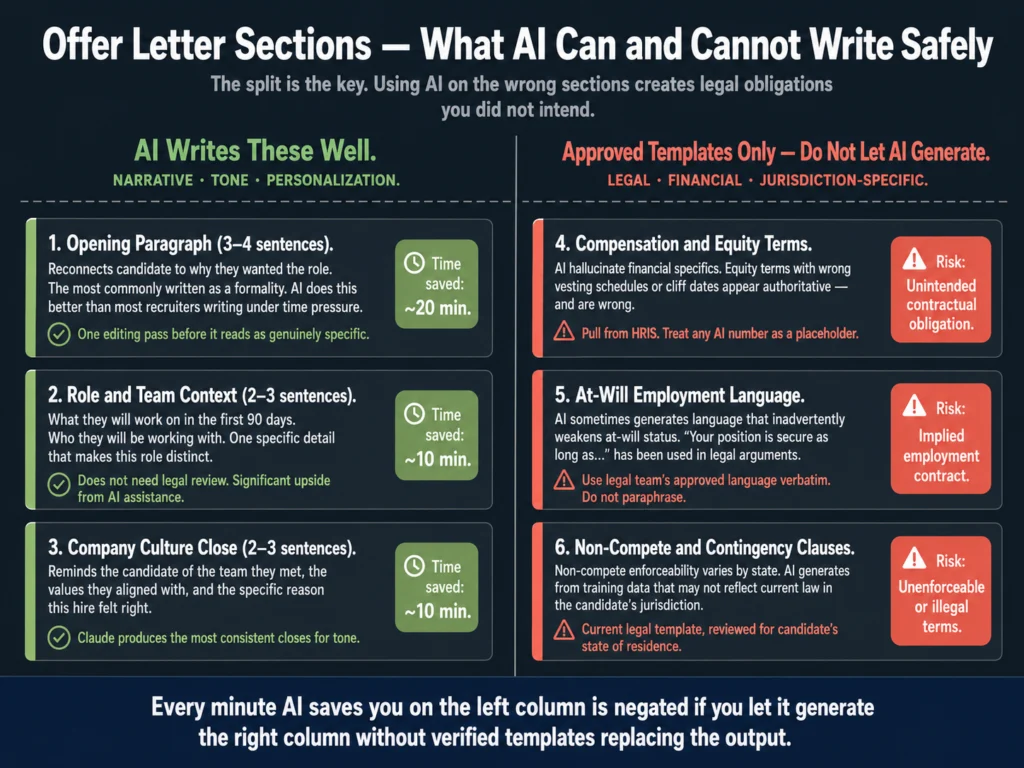
The Opening Paragraph
This is the highest-value section of any offer letter and the one most commonly written as a formality.
A generic opening — “We are pleased to extend this offer of employment for the position of [Job Title]” — works legally but does nothing for the candidate’s emotional experience of receiving the letter.
A well-prompted AI model generates an opening that reconnects the candidate to why they wanted the role.
On our testing of a Senior Product Manager offer letter, Claude produced an opening that referenced the candidate’s expressed interest in early-stage product work, framed the company’s stage of growth as an opportunity rather than a risk, and set an anticipatory tone rather than a transactional one.
The opening required one editing pass before it felt genuinely specific rather than AI-generated — but it was meaningfully better than the standard template.
The Role and Team Context Section
Most offer letters skip this entirely or include it as a single generic sentence.
Candidates who are deciding between offers are not choosing between salary figures in isolation.
They are choosing between visions of what the next two or three years of their career look like.
AI is good at generating role context from a brief. A prompt that includes the team size, current product stage, the three most important things this hire will work on in the first 90 days, and the hiring manager’s leadership style produces a paragraph that gives the candidate something concrete to hold.
This section does not need legal review. It benefits significantly from AI assistance.
The Company Culture Close
The final paragraph before the logistics is the last chance to sell. Most templates use it for administrative instructions.
A well-written close reminds the candidate of the team they met, the values they aligned with, and the specific reason this hire felt right.
Claude produces the most consistent closes for this tone. ChatGPT generates broader options to choose from.
Both are significantly better than what most recruiters write under time pressure at the end of a hiring cycle.
What AI Gets Wrong in Offer Letters
Compensation and Equity Terms
AI models hallucinate financial specifics. They will generate plausible-sounding compensation packages that do not match your actual offer.
More dangerously, they sometimes generate detailed equity descriptions — vesting schedules, cliff dates, exercise windows — that are legally specific but incorrect for your company’s actual plan terms.
In testing, both ChatGPT and Claude generated equity language in offer letters that was structurally accurate but contained specific terms (a four-year vesting schedule with a six-month cliff rather than the standard one-year) that did not match the brief we provided.
Neither model flagged that it was inventing specifics. Both produced text that looked authoritative.
The rule: compensation figures, equity terms, and benefit specifics must be pulled from your HRIS or compensation system, not generated by AI.
Treat any AI-generated number or financial term as a placeholder to be replaced, not a figure to be reviewed.
At-Will Employment Language
In the United States, at-will employment status (the employer’s right to terminate employment without cause) must be explicitly preserved in an offer letter.
AI models sometimes generate language that inadvertently creates implied contracts. Phrases like “your position is secure as long as you continue to perform” or “this role offers long-term career growth” can be argued to weaken at-will status in some jurisdictions.
Do not let AI generate the at-will language clause. Use your legal team’s approved template verbatim. This is not an area where paraphrasing is acceptable.
Non-Compete References
Non-compete enforceability has changed significantly across multiple states. California, Oklahoma, North Dakota, and Minnesota effectively prohibit them.
The FTC finalized a nationwide non-compete ban in April 2024, but federal courts blocked it before it could take effect.
The FTC formally abandoned the rule in September 2025 and officially removed it from federal regulations in early 2026.
Non-compete enforceability is now governed entirely by state law — and AI models generate non-compete language based on training data that may not reflect current state-level enforceability in your candidate’s jurisdiction.
Any non-compete, non-solicitation, or confidentiality language in an offer letter should come from a current legal template, reviewed by employment counsel for the candidate’s state of residence.
Writing Tool Recommendations
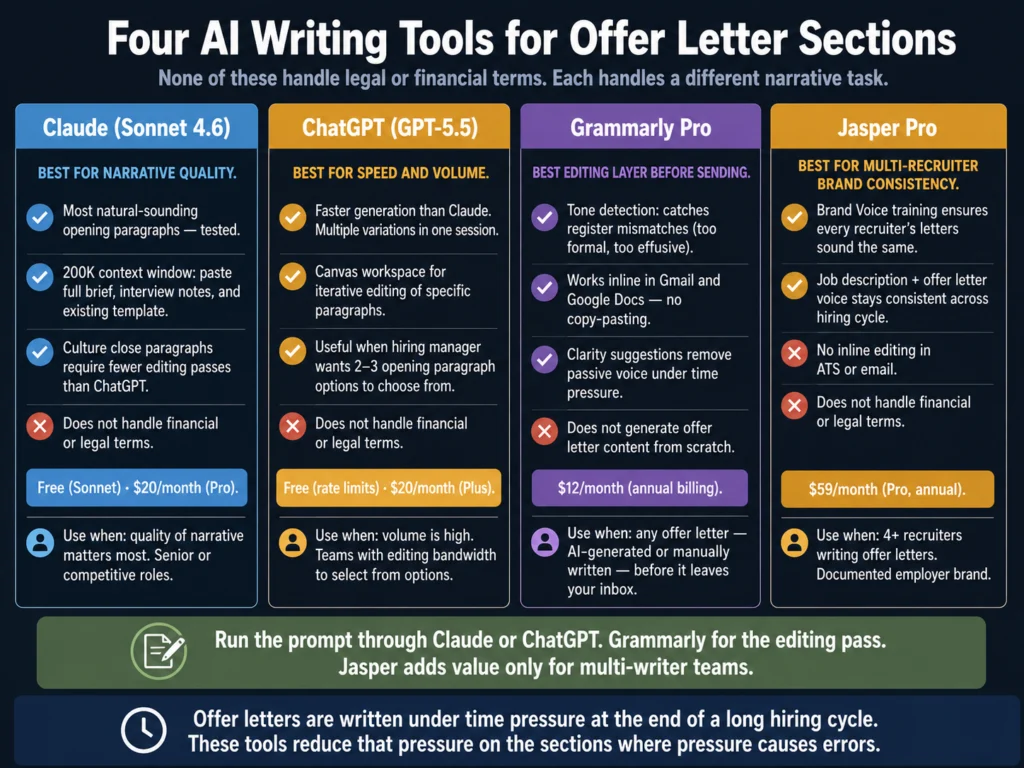
Claude (Sonnet 4.6) — Best for Narrative Quality
In testing offer letter language against the same brief across multiple tools, Claude produced the most natural, least templated-sounding narrative sections.
The opening paragraphs had better rhythm, the culture close felt more considered, and the role context section required fewer editing passes before it read as genuine rather than generated.
The 200K context window on Claude Sonnet 4.6 also matters for offer letters specifically: you can paste your entire brief (previous interview notes, candidate’s stated motivations, the hiring manager’s feedback, and your existing offer template) into a single session and generate a draft that genuinely reflects all of that context.
Best for: Narrative sections of the offer letter. Not for financial or legal terms.
Pricing: Free (Sonnet via Claude.ai) or $20/month (Pro, Opus 4.7 access).
ChatGPT — Best for Speed and Options
ChatGPT generates offer letter sections faster than Claude and produces more variations in a single session — useful when you want three different opening paragraph options to choose from rather than one to refine.
The Canvas workspace makes iterative editing of a draft easier than in Claude’s interface.
Best for: High-volume teams that need drafts quickly and have the editing bandwidth to select from multiple options.
Also useful when the hiring manager wants to see two or three versions of the role description before choosing one.
Pricing: Free (GPT-5.5 Instant, usage limits apply) or $20/month (Plus — removes usage limits and adds GPT-5.5 Thinking for longer, more complex drafts).
Grammarly Pro — Best Editing Layer Before Sending
An offer letter that reads as formal when it should read as warm, or as effusive when the company’s culture is direct, sends a signal about the organization before the candidate has even responded.
Grammarly’s tone detector catches register mismatches that human editors often miss under time pressure.
Run every offer letter, AI-generated or manually written, through Grammarly Pro before sending.
The tone detection and clarity suggestions apply to a document that a candidate will read carefully, multiple times, before deciding.
→ Grammarly Pro at $12/month is the editing layer that catches tone mismatches before an offer letter goes out. No other tool does this inline.
Jasper — Best for Brand Voice Consistency at Scale
For HR teams writing offer letters at volume — multiple roles, multiple departments, multiple team members involved in drafting — Jasper’s Brand Voice enforcement ensures that every letter sounds like it came from the same organization.
Without it, letters written by different recruiters drift toward different registers, and the candidate experience becomes inconsistent across your hiring funnel.
At $59/month (Pro, annual), Jasper is not justified for solo HR professionals writing fewer than 10 offers per month. For teams, the brand consistency argument holds.
→ Jasper’s 7-day free trial lets you test Brand Voice training on your existing offer letter templates before committing.
Offer Management Platforms That Include AI Features
These platforms handle the full operational workflow of offer letters, not just the writing.
If your current process involves manually assembling offer letters from scratch each time, one of these platforms eliminates that step — and the error risk that comes with it.
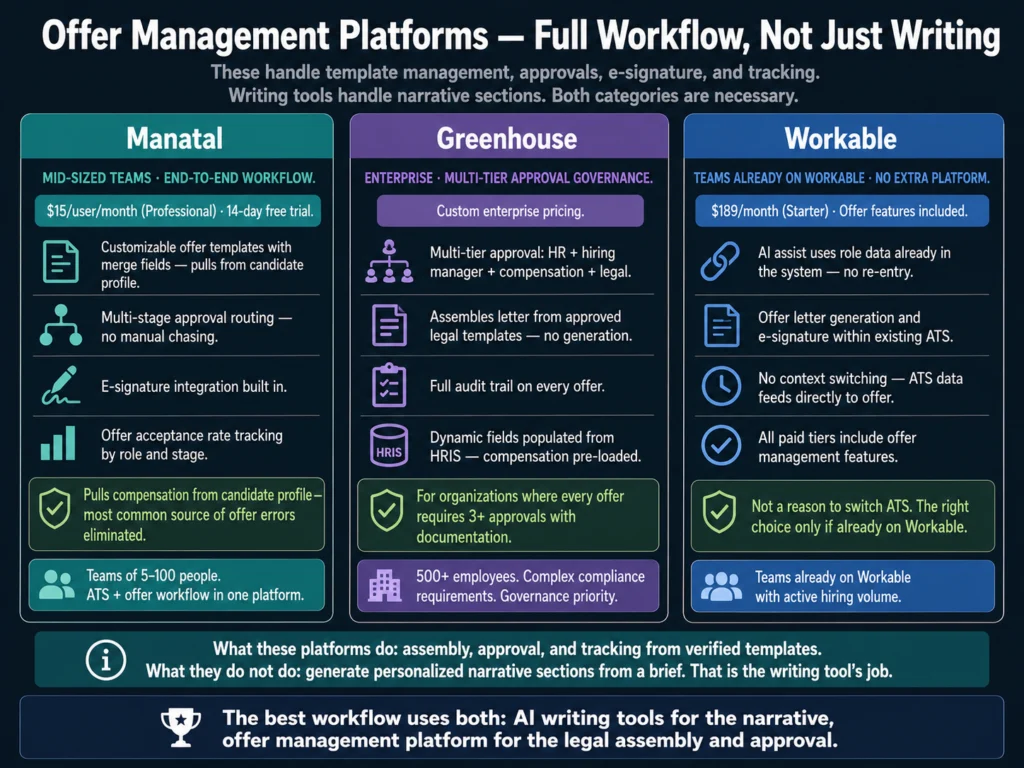
Manatal — Best for Mid-Sized Teams Needing End-to-End Offer Workflow
Manatal’s offer letter features include customizable templates with merge fields, multi-stage approval workflows, e-signature integration, and offer acceptance rate tracking by role and stage.
The platform pulls compensation data from the candidate profile rather than requiring manual entry, which is the most common source of offer letter errors.
The AI-powered elements in Manatal focus more on screening and ranking than on offer letter writing specifically.
But the template management and approval workflow significantly reduce the risk that AI-generated or manually drafted language makes it into a final offer without legal review.
Pricing: $15/user/month (Professional). 14-day free trial.
→ Manatal’s 14-day free trial includes the full offer letter workflow, approval routing, and e-signature features.
Greenhouse — Best for Enterprise Approval Workflows
Greenhouse’s offer management feature handles complex, multi-tier approval workflows — common in organizations where offer letters require sign-off from HR, the hiring manager, compensation, and legal before going out.
The offer letter is assembled from approved legal templates, with dynamic fields populated from the candidate’s HRIS profile.
Greenhouse does not generate offer letter content from scratch — it manages the assembly and approval of content you have already defined.
For organizations with established legal templates and a need for audit-trail governance on every offer, this is the right approach.
Pricing: Custom enterprise pricing.
Workable — Best for Teams Already in the Ecosystem
Workable includes offer letter generation and e-signature within its existing ATS. For teams already on Workable, the offer management features are included — no additional platform.
The AI assist feature within Workable helps draft offer letter content from the job role information already in the system.
Pricing: Starter at $189/month. Offer letter features included across paid tiers.
A Prompt Template for Offer Letter Narrative Sections
This prompt generates the three narrative sections of an offer letter that AI handles well.
The financial and legal sections should be added separately from approved templates.
You are writing the narrative sections of a job offer letter for [COMPANY NAME].
The letter should be warm, professional, and direct — not formal or bureaucratic.

Candidate details:
- Name: [FIRST NAME]
- Role being offered: [JOB TITLE]
- Level: [LEVEL]
- Department: [DEPARTMENT]
- Reports to: [MANAGER NAME AND TITLE]

Context for personalization:
- Why this candidate stood out in the process: [ONE SPECIFIC OBSERVATION]
- What they expressed most interest in during interviews: [WHAT MOTIVATED THEM]
- Team size they will join: [NUMBER] people
- One thing that makes this role and team distinctive: [SPECIFIC DETAIL]

Write three sections:

SECTION 1 — OPENING PARAGRAPH (3-4 sentences)
Express genuine excitement about making this offer. Reference the role
specifically. Connect to what the candidate said they were looking for.
Do not start with "We are pleased to" or "On behalf of." Make it sound
like a person wrote it.

SECTION 2 — ROLE AND TEAM CONTEXT (2-3 sentences)
Describe what the candidate will be working on and who they will be
working with. Include the specific detail provided. This section should
help the candidate see the first 90 days clearly.

SECTION 3 — CLOSING PARAGRAPH (2-3 sentences)
Affirm the company's confidence in this hire. Do not make promises
about promotion or tenure. End with a specific invitation to ask
questions before deciding — name a person to contact.

Do not include compensation details, start date, benefits, or legal
language. Those sections will be added separately.Review every output against the five checks covered in Can You Use AI-Generated Job Descriptions Legally? — the same principles that apply to job descriptions apply here, particularly around forward-looking language and inadvertent promises.
The Speed Factor: Why Timing Matters as Much as Content
A Gartner HR survey cited by the same analysis found that 44% of candidates in 2026 received multiple offers simultaneously — making the time between verbal offer and written offer a meaningful conversion variable.
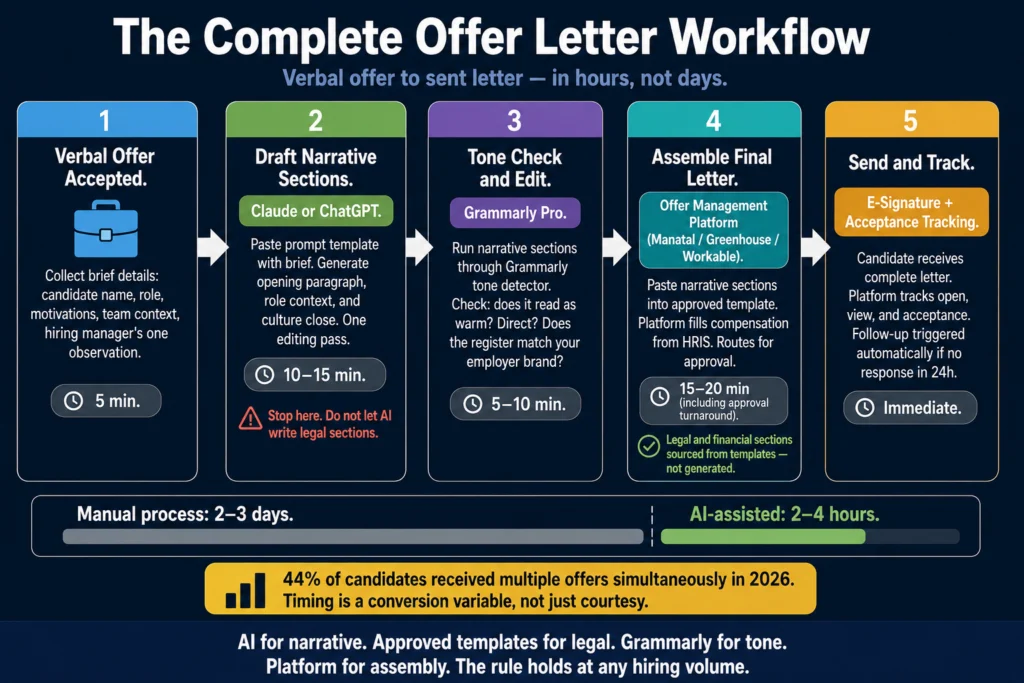
AI tools reduce offer letter drafting time significantly. A narrative draft that takes 45 minutes to write manually takes 5 to 10 minutes with the right prompt and a brief editing pass.
The remaining time belongs to the approval workflow and legal review, which platforms like Manatal and Greenhouse are designed to accelerate.
The practical workflow: use AI to draft the narrative sections as soon as a verbal offer is accepted, run through Grammarly for a tone check, then pass to your approved offer management platform for final assembly and routing.
The candidate receives a complete, polished offer letter within hours rather than days.
Related Reading
- How to Write Rejection Emails with AI — Without Sounding Robotic
- Free vs. Paid AI Tools for Small HR Teams
- Grammarly vs. Jasper for HR Writing — Which Should You Use?
- Can You Use AI-Generated Job Descriptions Legally?
- Best AI Tools for Writing Candidate Outreach Emails
- AI for HR Communications and Documentation — The Complete Guide
Frequently Asked Questions
You can, but you should not use the generated financial terms in a final offer without verification against your actual compensation offer. Both ChatGPT and Claude will generate plausible-sounding compensation packages, equity vesting schedules, and benefit descriptions — but they are pattern-matching from training data, not reading your actual HRIS or equity plan. Financial terms must be sourced from your compensation system, not generated fresh. Treat any AI-generated salary figure or equity term as a placeholder that must be replaced before the letter goes out. Use AI for the narrative sections and pull the financial terms from verified sources.
Yes, and the requirements vary by state. As of 2026, Colorado, California, New York, Washington, Illinois, and Massachusetts have pay transparency laws that affect job postings and, in some cases, offer letters. Some require that an offer letter include a salary range or the actual offered compensation; others require that the range was disclosed in the job posting before an offer is made. AI tools do not know your candidate’s state of residence or the applicable disclosure requirements there. Confirm the current requirements for the candidate’s jurisdiction before finalizing any offer letter.
At-will employment means either party can end the employment relationship at any time, for any legal reason, without notice — unless a contract says otherwise. In most U.S. states, employment is at-will by default, but offer letters can inadvertently weaken that status through language that implies a guaranteed employment period or specific termination conditions. Phrases like “your role is secure as long as you meet performance standards” or “we look forward to a long-term relationship” have been used in legal arguments to imply that a contractual commitment was made. Use your legal team’s approved at-will language verbatim in every offer letter. Do not paraphrase it, and do not let AI generate it.
An offer letter for most professional roles runs between one and two pages. It should cover: the role title and start date, compensation (base salary and any variable compensation), equity if applicable, benefits summary with a reference to the full benefits guide, at-will language, any contingencies (background check, drug test, reference verification), and the response deadline. The narrative sections covered in this article add context and personalization without extending the document materially. Anything beyond two pages typically reflects either over-specification (including information that belongs in an employment agreement, not an offer letter) or unnecessary legal language that should be reserved for a separate contract.
Employment law varies significantly across jurisdictions, and the at-will employment framework common in the United States does not apply in most other countries. In the UK, Germany, France, and most of the EU, employment contracts are regulated more tightly and offer letters often carry different legal weight than in the US. AI tools trained predominantly on US content will generate offer language that reflects US employment standards by default. For any offer to a candidate in a country where you have not previously hired, get legal review of the offer document from qualified employment counsel in that jurisdiction. Do not rely on AI-generated offer language for international hires without local legal validation.
Conclusion
The offer letter is the last document in your hiring process and the first document of the employment relationship.
It carries legal weight, sets tone, and either reinforces or undermines the impression the candidate built through your process.
AI handles the narrative sections of offer letters well — and with a structured prompt and a 15-minute editing pass, the letters it produces are meaningfully more personalized and better calibrated than what most recruiters write under time pressure.
That finding comes from what the Ailovyu team tested across multiple offer letter briefs, including a Senior PM role where Claude’s opening outperformed a standard template in every dimension we measured.
The speed advantage is real and matters in competitive markets.
The constraint is equally real. Financial terms, legal language, at-will clauses, and jurisdiction-specific disclosures must come from verified templates and legal review, not AI generation.
The rule is not complex: AI for narrative, approved templates for legal terms, Grammarly for tone, offer management platform for workflow.
An offer acceptance rate of 69.3% has a ceiling that compensation alone cannot raise.
The letter itself — how it reads, how quickly it arrives, how personally it speaks to why this candidate chose this process — is one of the few levers recruiters directly control.
We research and test AI tools so you can make informed decisions before spending money on them. Every review, comparison, and tutorial on this site is based on actual use, not vendor marketing.
Learn more on our About page.
Statistics sourced from NACEWEB Recruiting Benchmarks, Manatal 2026 Offer Acceptance Rate analysis, and Metaview 2026 AI and Hiring Alignment Report. Affiliate links in this article earn a commission at no extra cost to you — Grammarly, Jasper, and Manatal all have active affiliate programs. This does not affect editorial recommendations. This article is for informational purposes and does not constitute legal advice.