
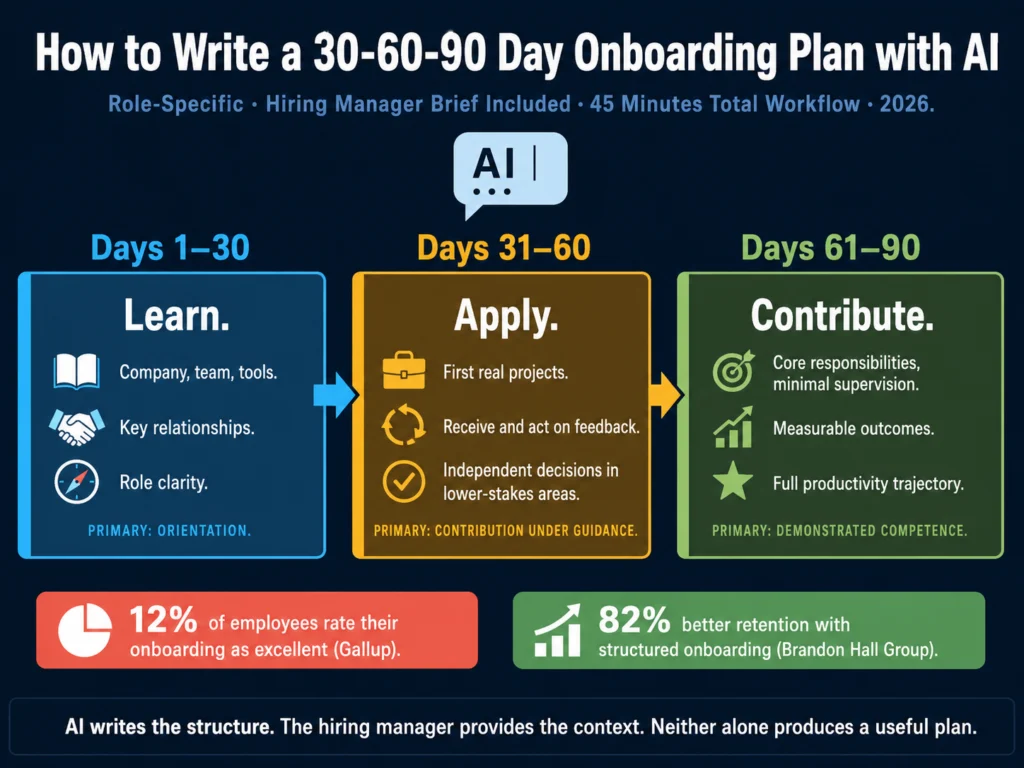
- Only 12% of employees strongly agree their organization does a great job of onboarding, according to Gallup. The data on what happens next is straightforward: 1 in 3 new hires leaves within the first 90 days when onboarding is poor, according to Jobvite research.
- A 30-60-90 day plan is the single most effective onboarding document HR can provide — and most companies use a generic version that does not reflect the actual role.
- AI writes the structure. The hiring manager provides the context. Neither alone produces a useful plan.
- This article includes a master prompt template, customization prompts for three role types (individual contributor, technical, managerial), and a hiring manager brief template for extracting the information AI needs.
- Total time to produce a role-specific 30-60-90 day plan with this workflow: 45 to 60 minutes, including the manager conversation.
Most onboarding fails quietly. HR is busy filling the next role before the last hire has finished their first week, and onboarding planning falls to the bottom of the list because nothing bad happens immediately when you skip it.
The consequences show up 60 days later, when a new hire who never got real clarity about what success looked like starts looking for another job.
Gallup research consistently finds that only 12% of employees strongly agree their organization does a great job of onboarding. That means 88% of workers rate their onboarding experience as inadequate.
Companies with strong onboarding programs improve new hire retention by 82% and productivity by over 70%, according to Brandon Hall Group research. The gap between what organizations know about onboarding and what they actually implement is substantial.
The 30-60-90 day plan is one of the most effective tools for closing that gap. It gives new hires role clarity — what they are expected to learn, demonstrate, and achieve at each stage.
It gives managers a shared accountability framework. And it gives HR a structured document they can hand off at the start of day one instead of hoping information filters through informally.
The problem is time. A good 30-60-90 day plan is role-specific. Generic templates — the same document with the same milestones applied to every new hire regardless of function — are better than nothing, but not by much.
AI makes role-specific plans achievable in under an hour.
- What Goes Into a 30-60-90 Day Plan
- Why Most Onboarding Plans Fail
- Before the Prompts: The Hiring Manager Brief
- The Master Prompt Template
- Customization Prompts for Three Role Types
- The Section Most Plans Miss: Pre-Day-One Preparation
- The Editing Pass: Before You Share the Plan
- Storing and Sharing the Plan
- Related Reading
- Frequently Asked Questions
- Conclusion
What Goes Into a 30-60-90 Day Plan
Before the prompts, understand the structure you are building. A 30-60-90 day plan covers three distinct phases, each with a different primary objective.
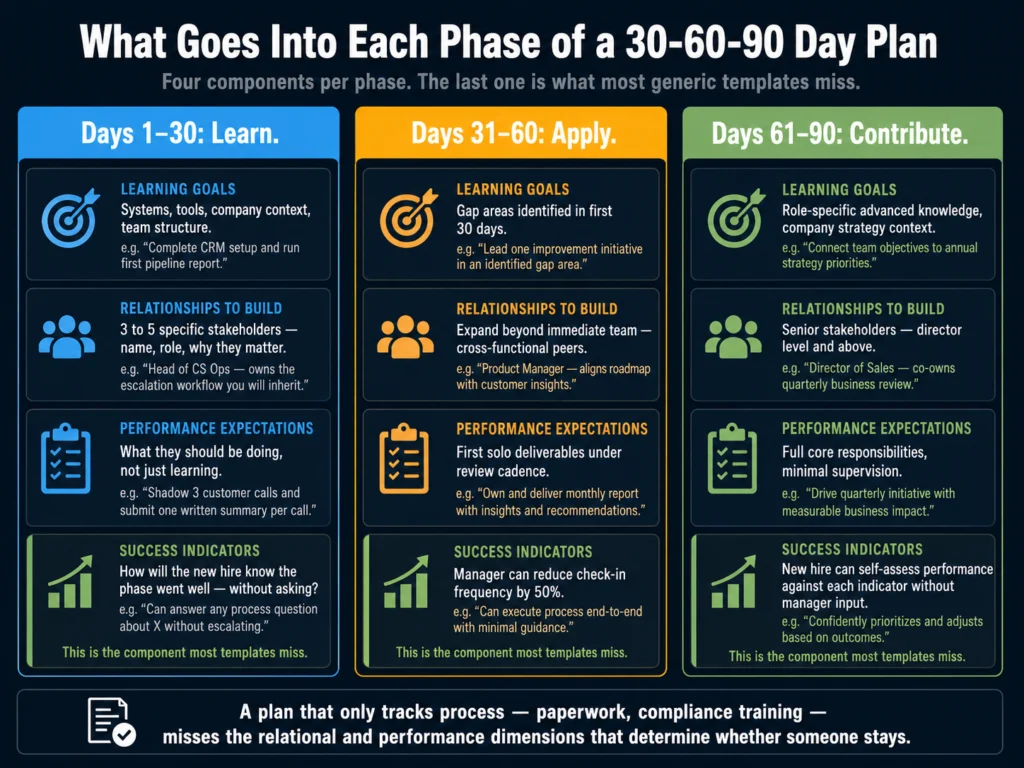
Days 1 to 30: Learn The first 30 days are about orientation — understanding the company, the team, the role, and the tools. The new hire is not expected to produce significant independent work yet.
Milestones in this phase center on completing training, meeting key stakeholders, and developing enough context to ask informed questions.
Days 31 to 60: Apply The second phase shifts from learning to doing — under guidance. The new hire takes on their first real projects, begins making independent decisions in lower-stakes areas, and starts building relationships beyond their immediate team.
Milestones in this phase involve delivering initial work, receiving and incorporating feedback, and identifying gaps in their knowledge or skills.
Days 61 to 90: Contribute The third phase is about demonstrating competence and operating with increasing independence.
By day 90, a new hire should be handling their core responsibilities without daily supervision, contributing meaningfully to team goals, and building toward full productivity.
Milestones in this phase are more outcome-oriented: specific deliverables, measurable contributions, or demonstrated skill benchmarks.
Each phase should include four components: learning goals, relationship-building targets, performance expectations, and success indicators.
The success indicators are the part most generic templates miss — they define what “done well” looks like at each stage, which is what new hires actually need to calibrate their own performance.
Why Most Onboarding Plans Fail
Enboarder’s 2025 research found that 60% of companies do not set clear goals or milestones for new hires. 28.8% of managers provide zero guidance or training to their new hires.
Only 36% of HR leaders describe the handoff between recruiting and onboarding as seamless.
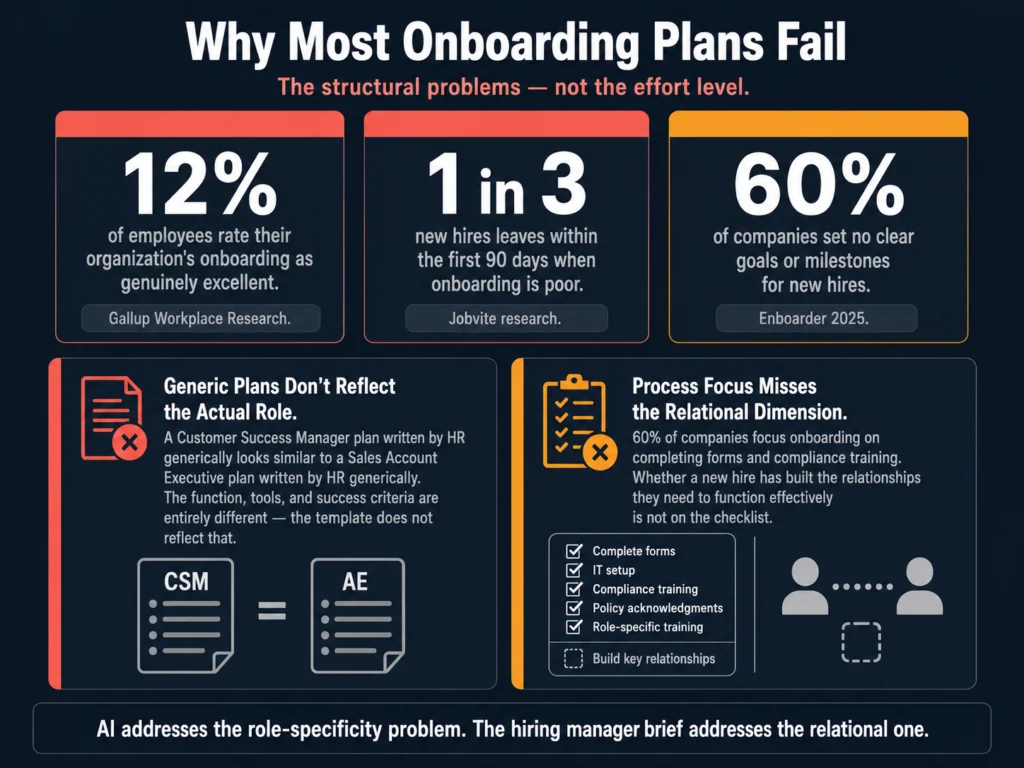
The structural problem: most 30-60-90 day plans are written by HR and reflect what HR thinks the role involves, not what the hiring manager expects the new hire to demonstrate.
A Customer Success Manager plan written by HR generically looks similar to a Sales Account Executive plan written by HR generically. The function, the tools, the relationships, and the success criteria are entirely different — but the template does not reflect that.
A secondary problem: 60% of companies focus onboarding on process rather than people. Completing paperwork and compliance training is measurable.
Whether a new hire has built a meaningful relationship with the colleague whose work is most relevant to theirs is not.
Plans that only track the process component miss the relational dimension that Enboarder’s research identifies as the second most common reason new hires leave early.
AI addresses the first problem — role-specificity — directly. It cannot address the second without the right inputs.
Before the Prompts: The Hiring Manager Brief
The most important step in building an AI-assisted onboarding plan is not the AI. It is the 20-minute conversation with the hiring manager that gives you the information AI needs to make the plan useful.
Use this prompt to extract the right information. Send it as a Google Form or a short email before you open any AI tool.
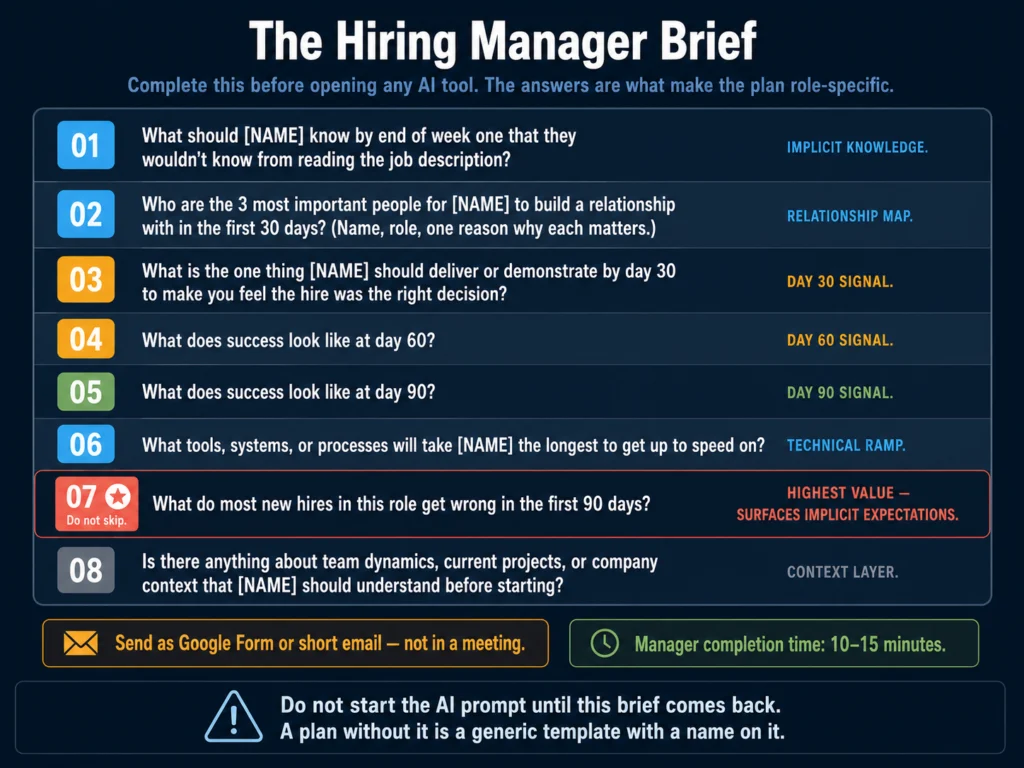
Hiring Manager Brief Template:
Before we finalize [NAME]'s onboarding plan, I need 15 minutes
of your input. Please answer the following:

1. What should [NAME] know by the end of week one that they
   would not know from reading the job description?

2. Who are the three most important people for [NAME] to build
   a working relationship with in the first 30 days?
   (Name and role, plus a one-line reason why each matters)

3. What is the one thing [NAME] should deliver or demonstrate
   by day 30 to make you feel the hire was the right decision?

4. What does success look like at day 60?

5. What does success look like at day 90?

6. What tools, systems, or processes will take [NAME] the
   longest to get up to speed on?

7. What do most new hires in this role get wrong in the
   first 90 days?

8. Is there anything about the team dynamics, current
   projects, or company context that [NAME] should
understand before starting?This brief takes the manager 10 to 15 minutes to complete. The answers to questions 4, 5, and 7 are the most valuable.
Question 7 in particular — what do most new hires in this role get wrong — surfaces the implicit expectations that never make it into a formal plan but determine whether someone is perceived as successful in the role.
Do not start the AI prompt until this brief comes back.
The Master Prompt Template
With the hiring manager brief in hand, open ChatGPT (GPT-5.5 Instant is adequate for this task; GPT-5.5 Thinking via Plus handles longer, more complex role briefs more precisely — particularly for senior or managerial roles where the brief contains dense context) or Claude.
You are an experienced HR professional building a 30-60-90 day
onboarding plan for a new hire.

Role: [JOB TITLE]
Level: [JUNIOR / MID / SENIOR / MANAGER]
Department: [DEPARTMENT]
Reports to: [MANAGER TITLE]
Company size: [COMPANY SIZE]
Work arrangement: [REMOTE / HYBRID / ON-SITE]

The plan should be structured in three phases:
- Days 1-30: Learning and orientation
- Days 31-60: Application and contribution under guidance
- Days 61-90: Independent contribution and performance demonstration

For each phase, include:
1. Learning goals (3-5 specific items to know or understand)
2. Relationships to build (specific roles or types of people,
   with one sentence on why each matters)
3. Performance expectations (what they should be doing,
   not just learning)
4. Success indicators (how the manager and new hire will know
   the phase went well — make these specific and measurable
   where possible)

Context from the hiring manager:
- Key knowledge for week one: [PASTE FROM BRIEF]
- Three most important relationships: [PASTE FROM BRIEF]
- Day 30 success indicator: [PASTE FROM BRIEF]
- Day 60 success indicator: [PASTE FROM BRIEF]
- Day 90 success indicator: [PASTE FROM BRIEF]
- Tools that take the longest to learn: [PASTE FROM BRIEF]
- What new hires most often get wrong: [PASTE FROM BRIEF]
- Additional team/company context: [PASTE FROM BRIEF]

Format the plan as a structured document with clear section
headers. Use plain language — this document will be given
directly to the new hire on day one. Avoid corporate jargon
and vague phrases like "build strong relationships" without
specifying with whom and why.This prompt produces a draft that is substantially more useful than any generic template because it incorporates the hiring manager’s actual expectations rather than HR’s assumptions about what the role requires.
Customization Prompts for Three Role Types
The master prompt handles most situations. These follow-up prompts address common gaps for specific role categories.
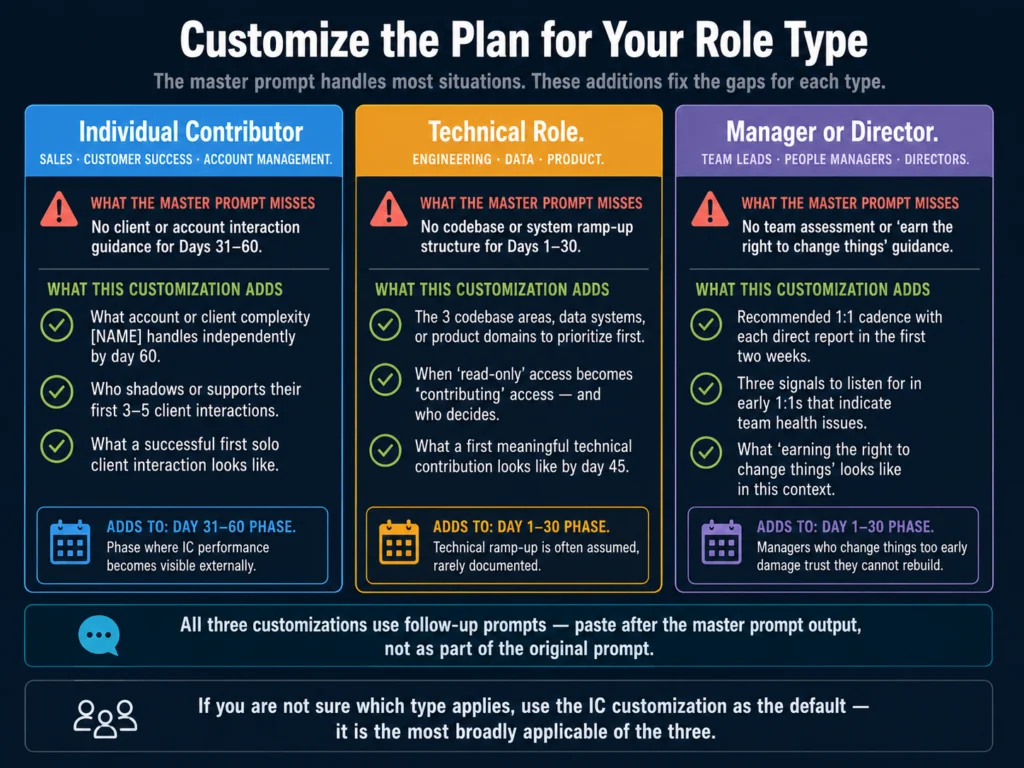
For individual contributor roles (sales, customer success, account management):
Add a section to the Day 31-60 phase called "First Client
or Account Interactions." Include:
- What level of account or client complexity [NAME] should
  handle independently by day 60
- Who should shadow or support them for their first [3-5]
  client interactions
- What a successful first solo client interaction looks like
- One thing to avoid in early client interactions that would
create a poor first impression for the companyFor technical roles (engineering, data, product):
Add a "Technical Ramp-Up" section to the Day 1-30 phase. Include:
- The three codebase areas, data systems, or product domains
  to prioritize understanding first (and why)
- The definition of "read-only" access vs. "contributing" access
  and when each is appropriate
- Who owns code review for [NAME]'s first pull requests or
  deliverables, and what the expected review turnaround is
- What a first meaningful technical contribution looks like
by day 45 (not just completing setup tasks)For managerial roles (team leads, people managers, directors):
Add a "Team and Stakeholder Assessment" section to the Day 1-30
phase. Include:
- A recommended schedule for 1:1s with each direct report in
  the first two weeks (frequency and duration)
- Three things to listen for in those early 1:1s that would
  signal team health issues to address early
- The organizational stakeholders outside the immediate team
  whose trust and alignment matters most by day 60
- What "earning the right to change things" looks like in this
  context — how much context should [NAME] build before
proposing structural or process changesThe Section Most Plans Miss: Pre-Day-One Preparation
A 30-60-90 day plan that starts on day one misses an opportunity. The best onboarding experiences begin before the new hire walks in the door.
Add this section at the beginning of every plan you produce:
Add a "Before Day One" section to the beginning of the plan. Include:
- What [NAME] should read or watch before starting
  (company handbook, product demo, key team presentation)
- Who will reach out to them before day one to confirm
  logistics and answer questions (name and role)
- Any accounts or tools they should set up in advance
  (if company policy allows pre-start access)
- One action [NAME] can take before day one to feel
  prepared — something that will reduce first-day anxiety
without requiring company accessResearch from FirstHR found that 70% of new hires know within the first month whether a job is a good fit — and 29% decide in the first week. Pre-day-one communication is the first signal a new hire receives about how their experience will be managed.
A single email from their hiring manager before they start — with their first-week schedule, the name of the person meeting them at the door, and one piece of genuine context about what the first day looks like — reduces early anxiety and sets a concrete expectation.
The Editing Pass: Before You Share the Plan
The onboarding plan is a document a new hire reads on their most anxious workday. Before sharing it, run it through the same editing discipline you would apply to any candidate-facing document.
Read it aloud. Any sentence that sounds like it was written by someone who does not know the new hire should be rewritten.
Phrases like “leverage your expertise to drive cross-functional value” are worse than useless — they signal that no one wrote this specifically for the person holding it.
Check for specificity. Every learning goal should reference a specific system, process, person, or outcome. “Learn how the team operates” is not a learning goal. “Shadow three customer calls with [Name] to understand how escalation requests are handled” is.
Check the success indicators. Each one should answer: how will the new hire know if they have met this milestone without asking their manager? If the indicator requires interpretation, make it more concrete.
Grammarly’s tone detector is useful at this stage — specifically for confirming that the document reads as warm and welcoming rather than evaluative or bureaucratic.
A 30-60-90 day plan that reads like a performance review framework before the hire has started sets an anxious tone from day one.
→ Grammarly Pro’s tone detection is the editing layer worth adding before any new-hire-facing document goes out.
Storing and Sharing the Plan
The format matters as much as the content. A 30-60-90 day plan buried in a PDF attached to a welcome email is less likely to be referenced than one shared in a Google Doc the new hire can access and annotate.
Recommended approach: store the plan in a Google Doc or Notion page shared with the new hire, their manager, and HR. This allows:
- The manager to add notes or updates as the role evolves
- The new hire to track their own progress and add context
- HR to review at the 30-day check-in without requesting a new document
If your organization uses an HRIS or onboarding platform (BambooHR, Workday, Leapsome), check whether it supports structured goal-setting within the onboarding workflow.
Many platforms have a built-in 30-60-90 day section that integrates the plan directly into performance check-in cadences.
Related Reading
- How to Write 10 Job Descriptions in One Day Using AI
- ChatGPT vs. Claude for HR Writing — A Practical Comparison
- Best AI Tools for Writing Interview Questions
- Using AI to Write Onboarding Documentation — A Full Guide
- How to Build an AI Prompt Library for HR Teams
- AI Writing Tools for Recruiters — The Complete Guide
- AI for HR Communications and Documentation — The Complete Guide
Frequently Asked Questions
With this workflow: 45 to 60 minutes total. The hiring manager brief takes 10 to 15 minutes to complete on the manager’s end. Reviewing the brief and building the prompt takes 10 minutes. The AI generates the initial draft in under two minutes. The editing and customization pass takes 15 to 20 minutes. If you have a template from a previous role in the same function, the editing pass is faster because you can compare against an existing calibrated example. First-time users typically take 75 to 90 minutes. After two or three iterations, the process is reliably under an hour.
Partially. The role-level structure — the general learning goals, tool ramp-up sequence, and stakeholder relationships for a Customer Success Manager, for example — can be reused across multiple hires into the same function. The success indicators for days 30, 60, and 90 should be reviewed and updated per hire based on the current team’s priorities and any context the manager provides about what this particular person needs to develop. The plan for a new CSM joining a team mid-quarter during a product launch is different from the same role hired at the start of a relatively stable period. Treat role-level structure as a reusable starting point, not a finished document.
Yes. Sharing the plan before day one serves two purposes. It reduces first-day anxiety by giving the new hire a concrete sense of what the first three months look like. And it signals that the organization planned for their arrival rather than scrambling once they showed up. Some organizations prefer to walk through the plan in the first one-on-one with the manager rather than sending it cold. Both approaches work — the important variable is that the conversation happens in the first week, not after the 30-day mark.
Do not produce the plan without it. A 30-60-90 day plan written without manager input is a generic template with a new hire’s name on it, which is only marginally better than no plan at all. If the manager cannot complete an 8-question brief before a hire’s start date, that is itself a signal about the onboarding experience the new hire is about to have. Escalate the completion of the brief to the manager’s manager if needed. The brief conversation is also useful preparation for the manager — it forces them to articulate what success looks like before the hire starts, rather than evaluating performance vaguely at the end of 90 days.
The day-90 success indicators in the plan should directly inform the 90-day performance conversation. If the plan specifies that by day 90 the new hire should be handling a specific volume of accounts independently, the 90-day check-in evaluates against that specific benchmark — not a generic “how are things going” conversation. This connection requires that HR and the manager agree on the success indicators before the hire starts, not after. It also means the plan is only useful if the 90-day check-in actually happens. Build the check-in into the calendar on day one. Scheduling it retroactively at day 85 produces a less useful conversation than one the new hire has been preparing for since week one.
Conclusion
The 30-60-90 day plan is not a form that HR fills out. It is a contract between the organization and a new hire about what the first three months will look like, what support the hire can expect, and how success will be defined.
Generic templates fulfill the first function — they give the hire a document. They rarely fulfill the second and third.
AI makes role-specific plans achievable at scale. The workflow is not complicated: a 20-minute hiring manager brief, a structured prompt, role-specific customization, and a 15-minute editing pass.
The output is a document a new hire can actually use to calibrate their own performance rather than waiting to receive feedback at the end of a quarter.
The Gallup statistic that only 12% of employees rate their onboarding as genuinely excellent is not a talent acquisition problem.
It is a documentation and planning problem. The tools to solve it are available and inexpensive.
The constraint is whether HR has a workflow that makes consistent, role-specific onboarding planning tractable.
The workflow in this article is one the Ailovyu team has refined specifically for HR professionals who need to produce role-specific plans without adding hours to an already full recruiting workload.
Onboarding statistics sourced from Gallup Workplace Research, Brandon Hall Group, Enboarder 2025 Report, FirstHR 2026 compilation, and Jobvite (1 in 3 new hires within 90 days stat). Affiliate links in this article earn a commission at no extra cost to you.
We research and test AI tools so you can make informed decisions before spending money on them. Every review, comparison, and tutorial on this site is based on actual use, not vendor marketing.
Learn more on our About page.