
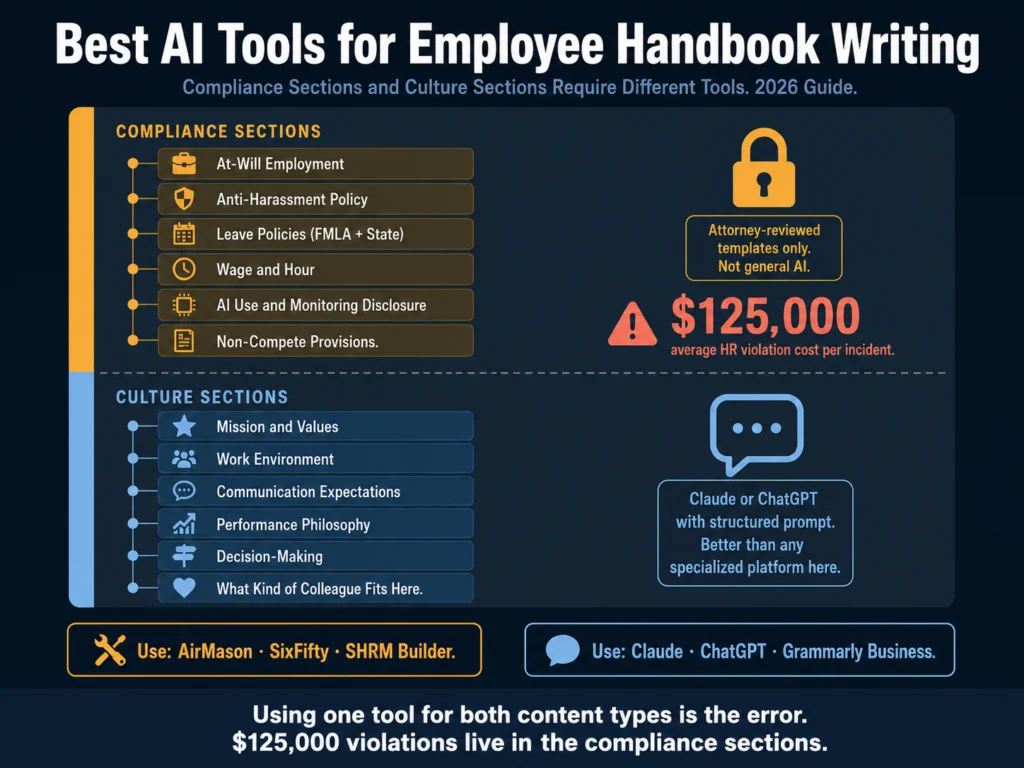
- HR violations cost small businesses an average of $125,000 per incident. An outdated or legally non-compliant handbook is direct exposure.
- Employee handbooks have two fundamentally different types of content: compliance sections (required legal language, state-specific policies) and culture sections (values, work environment, expectations). The right AI tool for one is wrong for the other.
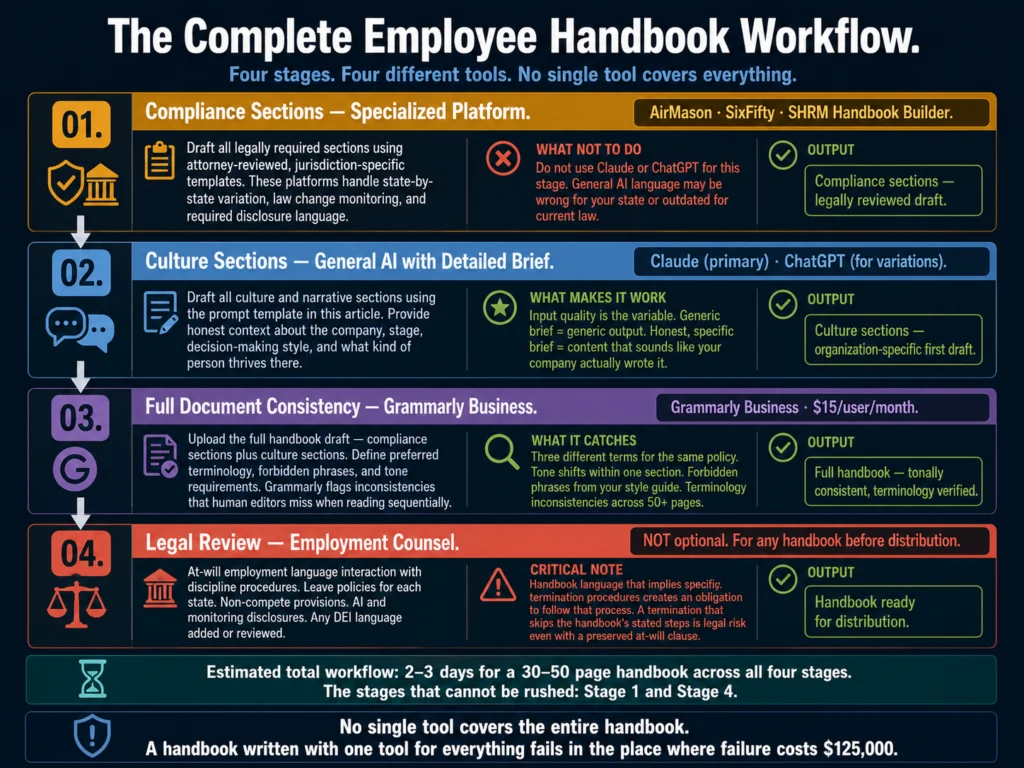
- For compliance sections: Use specialized handbook platforms — AirMason, SixFifty, or the SHRM Handbook Builder — not general AI. These platforms use attorney-reviewed templates updated continuously for state and federal law changes. General AI cannot do this reliably.
- For culture sections: Claude or ChatGPT with a structured prompt produce better first drafts than any specialized handbook platform.
- For consistency and tone across the full document: Grammarly Business is the right editing layer — its style guide enforcement catches terminology inconsistencies across a long document more reliably than manual review.
- Between 2023 and 2026, new laws on AI use in the workplace, SECURE 2.0, remote work monitoring, and DEI language changes made pre-2025 handbooks legally outdated. If your handbook has not been reviewed since 2024, it needs to be.
An employee handbook that no one reads is a compliance problem waiting to become a legal one.
HR violations cost small businesses an average of $125,000 per incident, and one of the most common sources of that exposure is an outdated handbook — policies that do not reflect current law, missing required disclosures, or at-will language that was weakened by well-intentioned additions.
64% of HR managers report lacking the time and resources to keep up with HR compliance challenges. The employee handbook is the document that is most likely to fall behind because it requires both legal expertise and writing time — neither of which is abundantly available in most HR functions.
AI addresses the writing time problem. It does not address the legal expertise problem.
The central argument of this article is that those two dimensions of employee handbook writing require different tools, and conflating them (using a general-purpose AI tool for compliance sections because it is fast) creates exactly the kind of risk handbooks are supposed to prevent.
- The Core Distinction: Compliance Sections vs. Culture Sections
- Tools for Compliance Sections
- Tools for Culture Sections
- Prompt Template for Culture Sections
- Editing the Full Handbook: Grammarly Business
- What Changed in 2026: The Update Checklist
- What Legal Must Review Before Finalizing
- Related Reading
- Frequently Asked Questions
- Conclusion
The Core Distinction: Compliance Sections vs. Culture Sections
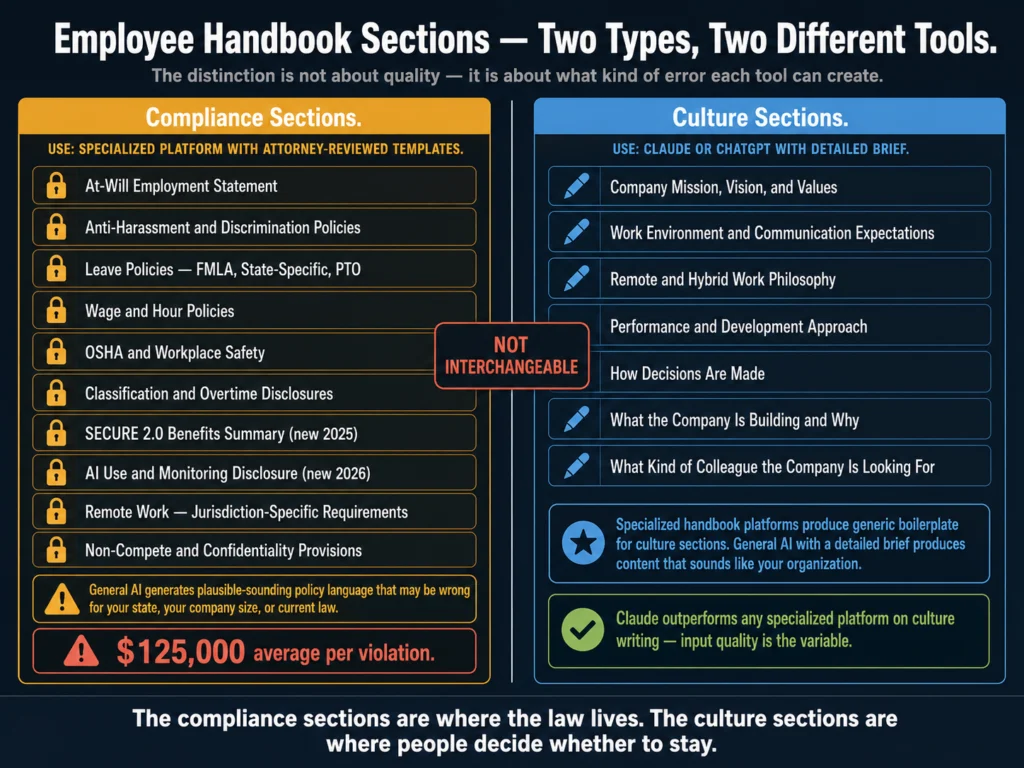
Every employee handbook contains two fundamentally different types of content.
Treating them the same way is the error most HR teams make when they try to use general AI for handbook writing.
Compliance Sections
These are the sections where the language is legally required, jurisdiction-specific, and must be accurate:
- At-will employment statement
- Anti-harassment and discrimination policies
- Leave policies (FMLA, state-specific leave, PTO)
- Wage and hour policies
- OSHA and workplace safety requirements
- Classification and overtime disclosures
- Benefits summary (SECURE 2.0 requirements from 2025)
- AI use and monitoring disclosure (new in several states for 2026)
- Remote work policies with jurisdiction-specific requirements
- Non-compete and confidentiality provisions
The language in these sections carries legal weight. Outdated policies (particularly anti-harassment procedures that list contacts who are no longer with the company, or leave policies that do not reflect current state law) create direct compliance risk.
General AI models generate plausible-sounding policy language that may be wrong for your state, wrong for your company size, or wrong for current law.
They do not know Colorado passed an AI Act effective June 30, 2026. They do not know that California’s leave requirements differ from Illinois’s.
Do not use general AI to write compliance sections. Use a platform with attorney-reviewed, jurisdiction-specific templates. The tools for this are covered below.
Culture Sections
These are the sections where tone and authentic expression matter more than legal precision:
- Company mission, vision, and values
- Work environment and communication expectations
- Remote and hybrid work philosophy
- Performance and development approach
- How decisions are made
- What the company is building and why
- What kind of colleague the company is looking for
For these sections, a specialized handbook compliance platform is the wrong tool — its attorney-reviewed templates produce generic, formal language that fails to capture what makes your organization specific.
General AI with a good prompt produces better culture content than any specialized platform.
Tools for Compliance Sections
AirMason — Best for Automated Compliance Monitoring
AirMason is the most feature-complete employee handbook platform for compliance-focused organizations.
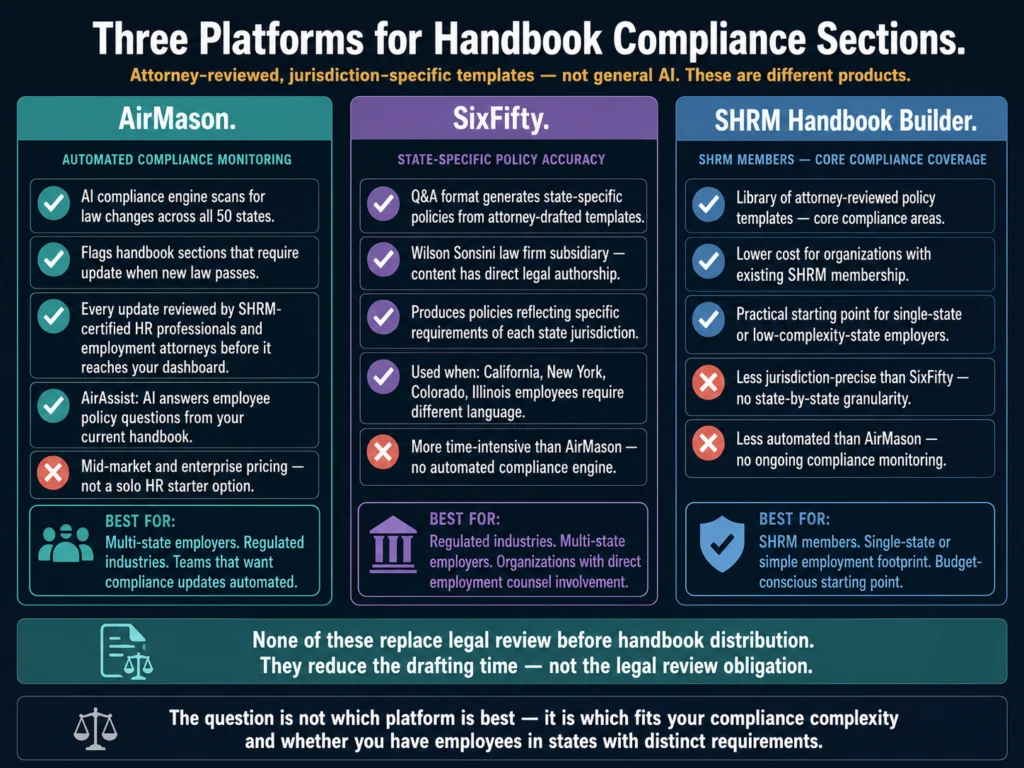
Its AI compliance engine scans for law changes across all 50 states and flags when your handbook requires an update.
When a new law passes — such as California’s SB 294 (the Workplace Know Your Rights Act, effective January 2026) — AirMason’s relevance filtering matches the change to your specific company configuration before surfacing it.
Critically, every update is reviewed by AirMason’s in-house team of SHRM-certified HR professionals and employment attorneys before it reaches your dashboard. This is the distinction from general AI: the content is attorney-verified, not AI-generated.
AirMason also includes AirAssist — an AI assistant that answers employee questions based on your current policies.
This addresses one of the most practical handbook problems: employees who would ask HR rather than searching the handbook. AirAssist deflects routine policy questions without requiring HR staff time.
Pricing: Contact AirMason for current pricing. Mid-market and enterprise focused.
Best for: Organizations in heavily regulated industries, multi-state employers, or any company that wants automated compliance updates rather than manual annual reviews.
SixFifty — Best for State-Specific Policy Accuracy
SixFifty is a subsidiary of the law firm Wilson Sonsini. Its handbook builder uses a question-and-answer format to generate state-specific policies from attorney-drafted templates.
For organizations with employees across multiple states — where California, New York, Colorado, and Illinois each have distinct requirements — SixFifty produces policies that reflect the specific requirements of each jurisdiction.
The Q&A format is more time-intensive than AirMason’s compliance engine, but it produces higher specificity for organizations in regulated industries where policy precision matters more than speed.
Pricing: Custom — request a demo from SixFifty.
Best for: U.S.-based companies in regulated industries (healthcare, finance, government contracting), multi-state employers, and organizations where employment counsel is directly involved in handbook development.
SHRM Employee Handbook Builder — Best for SHRM Members on a Budget
The SHRM Handbook Builder provides a library of attorney-reviewed policy templates that SHRM members can customize and combine into a handbook.
It is less automated than AirMason and less jurisdiction-precise than SixFifty, but it is accessible at a lower cost for organizations that already maintain SHRM membership.
The template library covers core compliance areas without state-by-state granularity.
For organizations with employees in a single state or in states without particularly complex employment law, SHRM’s builder is a practical starting point.
Pricing: Included with SHRM membership tiers. Verify current access levels on SHRM’s website.
Best for: SHRM members who need a compliant starting framework without the cost of a dedicated handbook platform.
Tools for Culture Sections
Claude (Sonnet 4.6) — Best for Authentic Culture Writing
Culture sections — values statements, communication expectations, work environment descriptions — fail when they sound like HR boilerplate.
A values statement that says “we are committed to excellence, integrity, and collaboration” says nothing that distinguishes your organization from any other.
A culture section that reflects the actual working conditions, decision-making style, and expectations of your specific team is the one employees actually read.
Claude produces more distinctive, specific cultural language than any other tool when given a detailed brief.
The key is input quality: a prompt that includes your actual mission context, how decisions are made, what the team is working toward, and what kind of person thrives at your organization produces culture content that sounds like it was written by someone who works there.
In testing culture section writing for a 120-person SaaS company, Claude produced a work environment description that the founding team said “sounds like us” — direct language, no corporate softening, specific about the ambiguity that characterizes the current stage.
The same prompt in a specialized handbook platform produced a generic paragraph indistinguishable from any other mid-stage startup’s handbook.
Best for: Mission and values sections, communication expectations, work environment descriptions, performance philosophy.
Pricing: Free (Sonnet via Claude.ai) or $20/month (Pro).
ChatGPT (GPT-5.5 Instant) — Best for Speed and Section Variation
ChatGPT generates culture section drafts faster and produces more variations per session.
When you need to show two or three versions of a values statement to the leadership team before selecting one, ChatGPT’s breadth is more useful than Claude’s quality-over-quantity approach.
Canvas makes the iterative editing workflow for handbook sections more efficient than Claude’s interface — you can highlight a specific paragraph and request a rewrite without regenerating the full section.
Best for: High-variation drafting, leadership team review sessions, iterative editing through Canvas.
Pricing: Free (GPT-5.5 Instant) or $20/month (Plus — removes usage limits and adds GPT-5.5 Thinking, useful for iterating through multiple handbook section drafts in a single session).
Prompt Template for Culture Sections
This prompt generates culture sections that reflect your specific organization rather than generic HR language.
You are writing the [SECTION NAME] section of an employee handbook for
[COMPANY NAME], a [COMPANY SIZE]-person [INDUSTRY] company based in
[LOCATION/REMOTE STATUS].

Company context:
- What the company is building and why: [MISSION IN 1–2 SENTENCES]
- Stage of the company: [EARLY-STAGE / GROWTH / ESTABLISHED]
- How decisions are made: [CENTRALIZED / DISTRIBUTED / CONSENSUS-BASED / etc.]
- What kind of person thrives here: [2–3 HONEST CHARACTERISTICS]
- What makes working here genuinely different from competitors:
  [ONE SPECIFIC, HONEST ANSWER — not "we move fast" or "great culture"]
- What does not work here, or what kinds of people should not apply:
  [HONEST ANSWER]

Write [SECTION NAME] in [WORD COUNT] words.

Requirements:
- Sound like your company actually wrote it — not a generic handbook template
- Use plain language — no corporate jargon, no abstract values statements
  that could apply to any company
- Be honest about what the company is at this stage — do not oversell
- Do not make promises about compensation, growth, or stability that
  the company has not committed to
- Avoid the following phrases: "passionate," "rockstar," "fast-paced
  environment," "wear many hats," "family," "excellence," "integrity"
unless they describe something specificEditing the Full Handbook: Grammarly Business
A handbook written across multiple tools (compliance sections from AirMason or SixFifty, culture sections from Claude, employee-contributed sections from HR team members) will be tonally inconsistent unless edited as a unified document.
The contrast between attorney-drafted policy language and warm values statements is appropriate. Inconsistency within those categories — three different terms for the same policy, shifting formality within a single section — is not.
Grammarly Business’s style guide enforcement is the right editing layer for a handbook. You define preferred terminology, forbidden phrases, and tone requirements.
Grammarly applies them across the entire document, flagging inconsistencies that a human editor reading sequentially would miss.
→ Grammarly Business at $15/user/month adds style guide enforcement that catches terminology inconsistencies across a full handbook document.
What Changed in 2026: The Update Checklist
Between 2023 and 2026, new laws made pre-2025 handbooks legally outdated almost overnight, according to SixFifty’s handbook update analysis.
Five areas that every handbook should address for 2026:
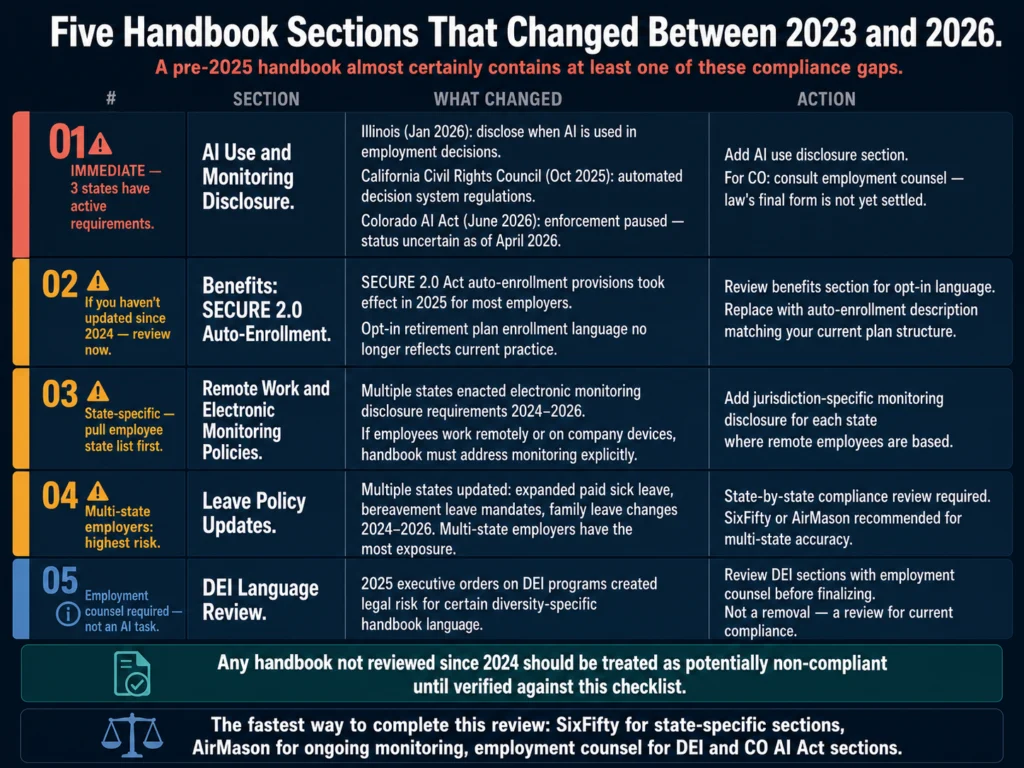
1. AI Use and Monitoring Disclosure Illinois (effective January 1, 2026) requires disclosure when AI is used in employment decisions.
California’s Civil Rights Council regulations (effective October 1, 2025) address automated decision systems broadly. Colorado’s AI Act (SB 24-205, effective June 30, 2026, enforcement status uncertain) introduces impact assessment requirements for employers using high-risk AI systems.
As of April 2026, a federal court has paused enforcement during ongoing litigation, and the Colorado legislature is considering SB 26-189 which may substantially rewrite the law.
If your organization has employees in Colorado and uses AI in employment decisions, monitor developments and consult employment counsel before finalizing handbook language on this section — the law’s final form is not yet settled.
For all three states, if your handbook does not address how the company uses AI in hiring, performance management, or employee monitoring, it needs to be reviewed.
2. SECURE 2.0 Auto-Enrollment The SECURE 2.0 Act’s auto-enrollment provisions took effect in 2025 for most employers.
If your benefits section still describes opt-in retirement plan enrollment, it may not reflect current practice or legal requirements.
3. Remote Work and Electronic Monitoring Policies Multiple states have enacted electronic monitoring disclosure requirements.
If your company monitors employee activity on company devices or networks — or if employees work remotely — your handbook should address this explicitly with jurisdiction-specific language.
4. Leave Policy Updates Multiple states updated leave requirements between 2024 and 2026: expanded paid sick leave, bereavement leave mandates, and changes to family leave.
A state-by-state compliance review is necessary for organizations with multi-state employees.
5. DEI Language Review The Trump administration’s 2025 executive orders on DEI programs created legal risk for certain types of diversity-specific language in employee handbooks.
Organizations should review their DEI sections with employment counsel to ensure they reflect current compliance requirements without creating new legal exposure.
What Legal Must Review Before Finalizing
Regardless of which tools you used to draft the handbook, legal review is non-negotiable before the document is distributed to employees.
The sections that carry the most legal risk and require the closest review: at-will employment language (especially how it interacts with progressive discipline language elsewhere in the handbook), leave policies for each state in which you have employees, non-compete and confidentiality provisions, and any AI use or monitoring disclosure added for 2026 compliance.
Handbooks should also be reviewed for internal consistency — particularly between the discipline and termination sections and the performance review language.
Handbook language that implies a specific process for termination creates an obligation to follow that process.
A termination that does not follow the handbook’s stated procedure is a legal risk even if the at-will employment clause is preserved.
Related Reading
- How to Write a 30-60-90 Day Onboarding Plan with AI
- Can You Use AI-Generated Job Descriptions Legally?
- Best AI Tools for Performance Review Writing
- Using AI to Write Onboarding Documentation — A Full Guide
- AI for HR Communications and Documentation — The Complete Guide
Frequently Asked Questions
For the culture and narrative sections, yes — and the output is often better than what specialized platforms produce for those sections. For the compliance sections (leave policies, anti-harassment procedures, classification language, required disclosures), no. General AI models generate policy language that sounds authoritative but may be wrong for your state, your company size, or current law. The risk is not immediately visible: the language looks like a real policy. It becomes visible when an employee files a complaint and the policy does not comply with current state law. Use attorney-reviewed templates for compliance sections and general AI for culture sections.
At minimum, annually. In practice, compliance-driven updates should be triggered by law changes — which means the right answer is to track employment law changes continuously and update affected sections as they occur, rather than conducting one large annual review. Specialized platforms like AirMason automate this monitoring. For organizations without a dedicated handbook platform, the HR compliance calendar for 2026 includes January as the month to review and update the handbook, before the start of the employment year. Any significant law change in your operating states should trigger an immediate handbook review of the relevant sections.
It can, inadvertently. Courts in multiple states have ruled that handbook language implying specific procedures for termination, guaranteed employment periods, or binding promises about benefits creates implied contractual obligations. This is why at-will employment language must be explicit, why forward-looking promises about compensation or career growth should be avoided, and why progressive discipline language should be carefully reviewed to ensure it does not imply that dismissal can only occur after a specific sequence of steps. An employment attorney reviewing the handbook before distribution is the best protection against creating unintended contractual obligations.
Long enough to cover required disclosures and core policies; short enough that employees will actually read it. For most organizations, 30 to 50 pages covers the necessary ground without becoming a document that functions as an obstacle rather than a resource. The most common length error is bloat from policies that belong in operational documentation — specific procedures, step-by-step workflows, role-specific requirements — rather than in the handbook itself. The handbook should set principles and legal requirements. Detailed procedures go elsewhere.
With careful structuring, yes. The most common approach is a core handbook covering company-wide policies and culture, with state-specific addenda covering jurisdiction-specific requirements for each state where you have employees. This structure is more maintainable than trying to accommodate every state’s variations within a single document — state addenda can be updated when specific laws change without requiring a review of the entire handbook. SixFifty and AirMason both support this structure. General AI tools do not produce state-specific addenda reliably — this is precisely the use case where attorney-reviewed jurisdiction-specific templates are essential.
Conclusion
The employee handbook is the only HR document that serves simultaneously as a legal compliance instrument, an employment contract modifier, a cultural onboarding tool, and an employee reference document.
No other document HR produces carries that range of functions — or that range of risk when it fails.
AI tools make the handbook writing process faster and, in the right sections, produce better cultural content than most HR teams generate under time pressure.
But the compliance sections (the sections where $125,000-per-incident violations live) require attorney-reviewed templates, not AI generation.
The right workflow is not complicated: specialized platform for compliance sections, Claude or ChatGPT for culture sections, Grammarly Business for consistency across the full document, and employment counsel for legal review before distribution.
No single tool covers all of it. A handbook that tries to use one tool for everything will fail in the place where failure is most expensive.
The compliance vs. culture framework in this article is what the Ailovyu team has found consistently holds up across organizations at different sizes and stages.
The boundary between those two types of content is where most handbook errors originate.
We research and test AI tools so you can make informed decisions before spending money on them. Every review, comparison, and tutorial on this site is based on actual use, not vendor marketing.
Learn more on our About page.
Statistics sourced from AirMason 2026 California Labor Law Compliance analysis, GoCo HR compliance resources, SixFifty employee handbook update checklist (2026), and Mitratech Mineral 2026 handbook update guide. This article is for informational purposes and does not constitute legal advice. Affiliate links in this article earn a commission at no extra cost to you.