
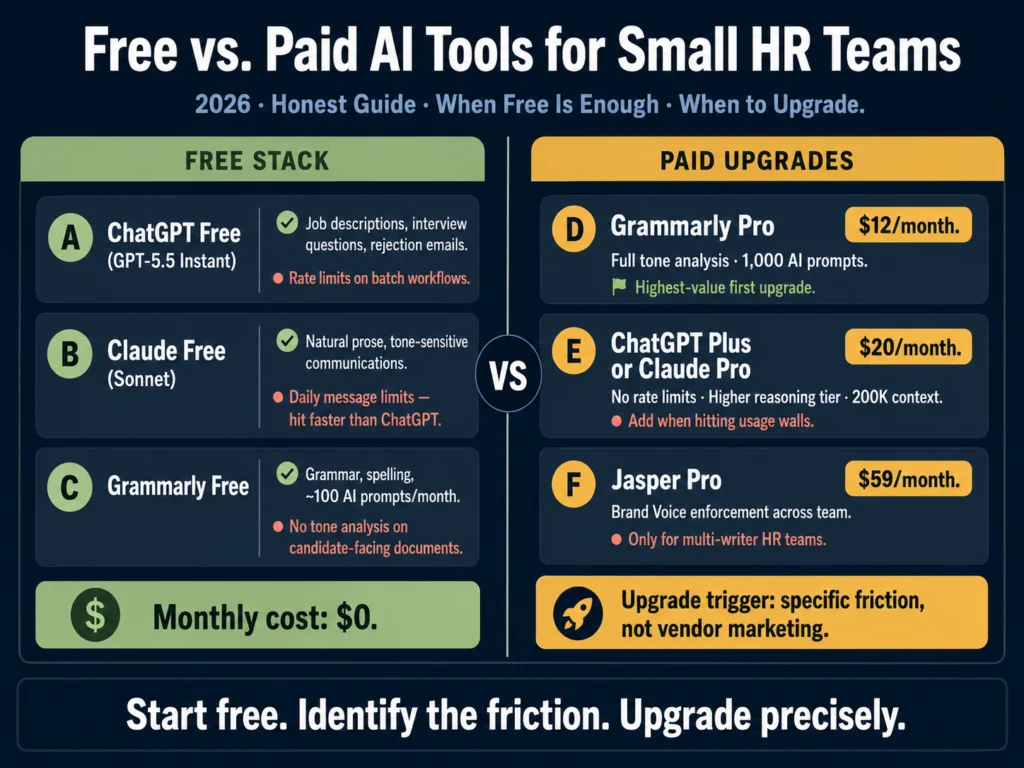
- A small HR team can run a functional AI-assisted writing workflow entirely on free tools. The quality is not meaningfully worse than paid options for most tasks.
- The free stack that covers 80% of needs: ChatGPT free (GPT-5.5 Instant) + Claude free (Sonnet) + Grammarly free. Total cost: $0.
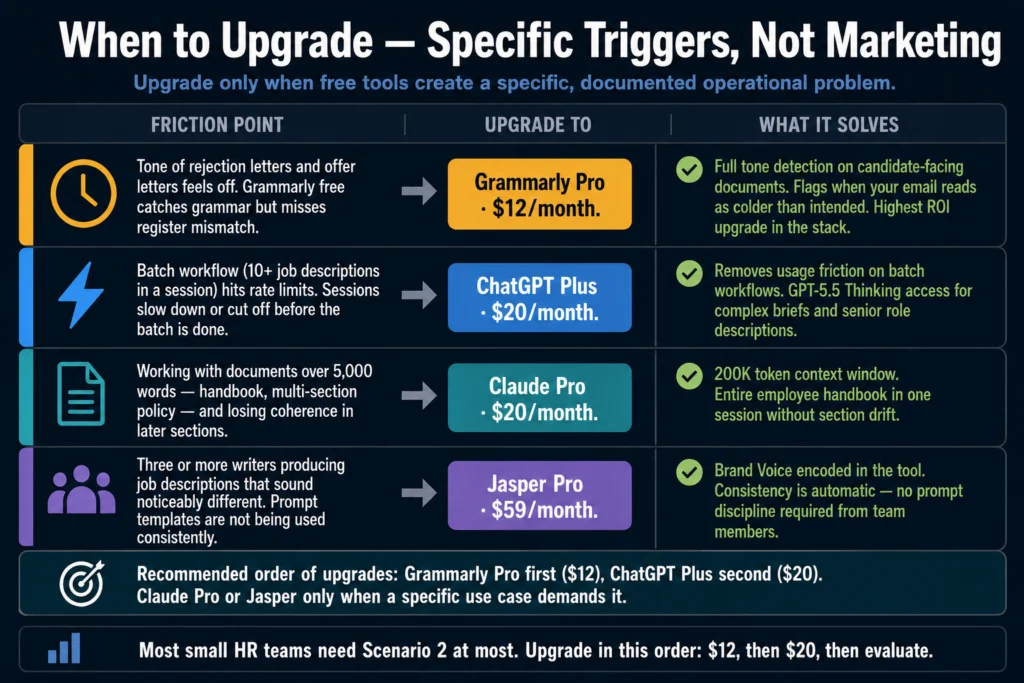
- The minimum paid upgrade: Grammarly Pro at $12/month (annual) adds full tone analysis and 1,000 AI prompts. This is the highest-value single upgrade for HR writers.
- When to add ChatGPT Plus or Claude Pro ($20/month): When you regularly work with long documents, need consistently higher output quality on senior or complex roles, or hit usage limits on the free tier.
- When to add Jasper ($39–$59/month): Only when multiple writers need Brand Voice enforcement and your employer brand is documented. Not justified for solo HR professionals or low-volume teams.
- Copy.ai’s free plan (2,000 words/month, no expiry) is the best free option for template-driven job description drafting if you want structure without prompt engineering.
Small HR teams rarely have a software budget that scales with their workload.
A two-person HR function at a 150-person company is expected to produce the same quality of job descriptions, candidate communications, and onboarding materials as a team five times its size.
AI tools help close that gap — but the question of which tools actually justify their monthly cost versus which free alternatives cover the same ground is worth answering directly.
The short answer: free AI tools in 2026 are genuinely capable. The gap between free and paid has narrowed significantly.
You can build an effective HR writing workflow without spending anything in your first six months.
The paid upgrades that justify their cost are specific and limited — and most small HR teams do not need all of them.
This guide breaks down the free and paid options by use case, gives you honest assessments of where free plans hit their limits, and ends with three budget scenarios for teams at different stages.
The Free Stack: What You Actually Get
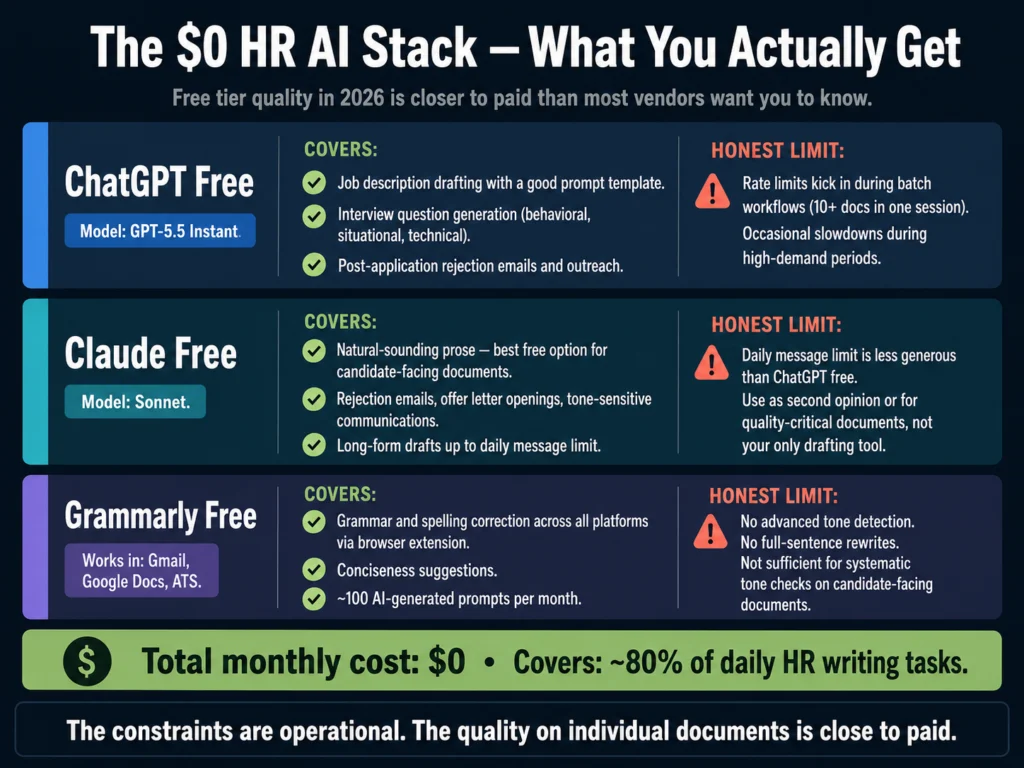
Three free tools form the foundation of a zero-cost HR AI workflow.
ChatGPT Free (GPT-5.5 Instant)
The free ChatGPT tier now runs on GPT-5.5 Instant, which became the default model on May 5, 2026, replacing GPT-5.3 Instant.
GPT-4o was deprecated in February 2026, with GPT-5.3 Instant serving as the interim default before GPT-5.5 Instant took over.
This is a substantial improvement over what the free tier offered a year ago. GPT-5.5 Instant handles job description drafting, interview question generation, rejection email writing, and basic policy drafts competently, with a well-constructed prompt.
Honest limit: The free tier has usage limits that kick in during high-demand periods, occasionally producing slower responses or rate limiting when you are trying to run a batch workflow.
For most HR writers handling fewer than 20 documents per week, this is not a practical problem.
For batch workflows (10+ job descriptions in a single session), ChatGPT Plus ($20/month) removes those friction points.
Claude Free (Sonnet Models)
Claude’s free tier uses Sonnet models, which handle most HR writing tasks without noticeable quality compromise.
As covered in ChatGPT vs. Claude for HR Writing — A Practical Comparison, Claude produces more natural-sounding prose and is marginally better at maintaining tone consistency across longer documents.
The free tier has daily usage limits that are less generous than ChatGPT’s.
Honest limit: Claude’s free tier hits its daily message limit faster than ChatGPT’s, which makes it less suited as your only drafting tool.
Use it as a second opinion or for the specific tasks where its writing quality advantage matters most — rejection emails, offer letters, tone-sensitive candidate communications.
Grammarly Free
Grammarly Free catches roughly 60 to 70% of the issues that Premium catches.
For HR writing, that means basic grammar and spelling correction, conciseness suggestions, and a limited number of AI-generated prompts (approximately 100 per month).
The browser extension works across Gmail, Google Docs, LinkedIn, and most ATS platforms — meaning it runs in the background of wherever you already write.
Honest limit: No advanced tone detection, no full-sentence rewrites, and no plagiarism check on the free tier. For internal memos and emails, the free tier is sufficient.
For documents that a candidate will read (rejection letters, offer letters, job descriptions), the Premium tone analysis catches mismatch between intended and actual tone that the free tier misses.
Use Case Breakdown: Free vs. Paid
Job Description Writing
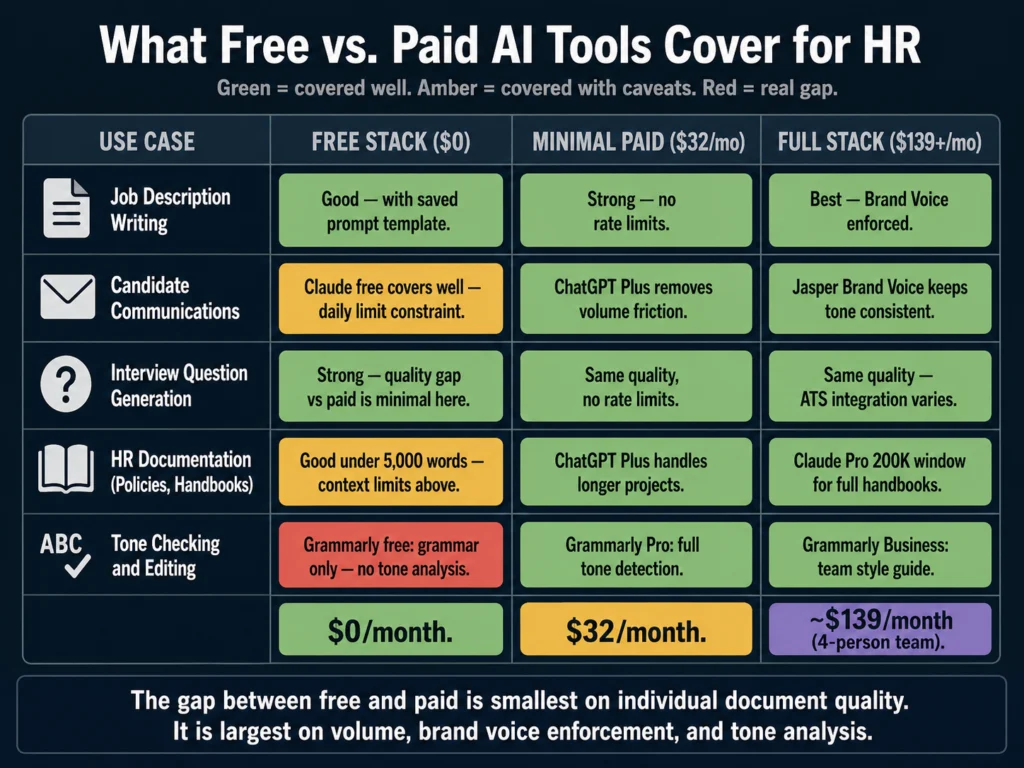
Free coverage: ChatGPT free with a saved prompt template handles this well for straightforward roles.
Copy.ai’s free plan (2,000 words/month, no expiry) provides a form-based interface that is faster for users who find prompt engineering unfamiliar.
The form structure guides you through the inputs without requiring expertise.
Where free falls short: Brand voice consistency across a team of writers. Free tools require every writer to use the same prompt template manually.
They will not. If you have three recruiters writing job descriptions independently, the outputs will sound different without an enforcement mechanism.
This is where Jasper’s Brand Voice feature earns its cost, but only for multi-writer teams.
Recommended free approach: ChatGPT free + a master prompt template saved in a shared Google Doc. For the prompt structure, see How to Write 10 Job Descriptions in One Day Using AI.
Upgrade trigger: Three or more writers producing job descriptions, documented employer brand that is not being consistently applied.
Candidate Communications (Rejection Emails, Outreach)
Free coverage: Claude free produces the most natural-sounding candidate communications of any free tool.
A good prompt with specific candidate details (role, stage, one genuine observation) produces rejection emails that do not read as obviously automated.
For a full workflow on this, see How to Write Rejection Emails with AI (Without Sounding Robotic).
Where free falls short: Volume. If you are sending 40 rejection emails per week, Claude’s free tier daily message limit becomes a bottleneck.
ChatGPT Plus ($20/month) removes usage constraints and handles this volume without friction.
Recommended free approach: Claude free for sensitive communications (final-round rejections, offer letters). ChatGPT free for high-volume post-application rejections.
Upgrade trigger: Sending more than 30 candidate emails per week and hitting daily message limits.
Interview Question Generation
Free coverage: Both ChatGPT free and Claude free generate strong role-specific behavioral and situational interview questions with a well-structured prompt.
The quality difference between free and paid here is minimal. For the prompts, see Best AI Tools for Writing Interview Questions.
Where free falls short: Real-time interview support. Tools like Clovers, which provide in-the-moment question suggestions during live interviews, are paid products with no free tier.
For teams where interviewer consistency is a documented problem, those tools address something free general-purpose AI cannot.
Upgrade trigger: You need real-time interview support or ATS-integrated question libraries, not just standalone question generation.
HR Documentation (Policies, Handbooks, Onboarding)
Free coverage: ChatGPT free handles longer policy documents well with GPT-5.5 Instant. For a flexible work policy or an onboarding guide under 1,000 words, the free tier produces a solid first draft.
The main limitation is context window. For very long documents (full employee handbook, multi-section policy manual), ChatGPT free may not hold coherence across the full length.
Where free falls short: Extended context on long documents. Claude Pro ($20/month) includes a 200K token context window, which allows processing an entire employee handbook in a single session without losing coherence in later sections.
ChatGPT Plus runs on GPT-5.5 Thinking, which offers a significantly larger context window than the deprecated GPT-4o — making the context window gap between the two tools less pronounced than it was a year ago.
For most HR documents under 50,000 words, both tools now handle the full document in a single session.
The Claude Pro advantage on context is most relevant for very large projects: multi-section policy manuals, full employee handbooks combined with annexes, or extended onboarding documentation sets.
Upgrade trigger: You regularly work with HR documents exceeding 5,000 words in a single session.
Tone Checking and Editing
Free coverage: Grammarly free handles basic grammar and spelling. For internal documents, it is sufficient.
Where free falls short: Tone analysis for candidate-facing documents. Grammarly Premium (now called Grammarly Pro) adds full tone detection: whether your job description reads as confident, warm, or inadvertently harsh.
For HR teams where candidate-facing document quality directly affects employer brand, this is the single highest-value paid upgrade in the stack.
Upgrade trigger: You regularly produce candidate-facing documents and want a systematic tone check before publishing. At $12/month (annual billing), this is the lowest-cost meaningful upgrade in the HR AI stack.
→ Grammarly Pro is $12/month on annual billing — the most cost-effective paid upgrade for HR writers.
Honest Pricing Table: What You Get at Each Level
| Tool | Free Tier | Paid Tier | Monthly Cost (Annual) | HR Value |
|---|---|---|---|---|
| ChatGPT | GPT-5.5 Instant, usage limits | GPT-5.5 Thinking, higher limits | $20 | High |
| Claude | Sonnet, daily message limits | Opus 4.7, 200K context | $20 | High |
| Grammarly | Basic grammar, 100 AI prompts | Full tone, 1,000 prompts | $12 | High for candidate docs |
| Copy.ai | 2,000 words/month, templates | Unlimited words, workflows | $49 | Medium for template users |
| Jasper | 7-day trial only | Brand Voice, 50+ templates | $39–$59 | High for multi-writer teams |
Three Budget Scenarios
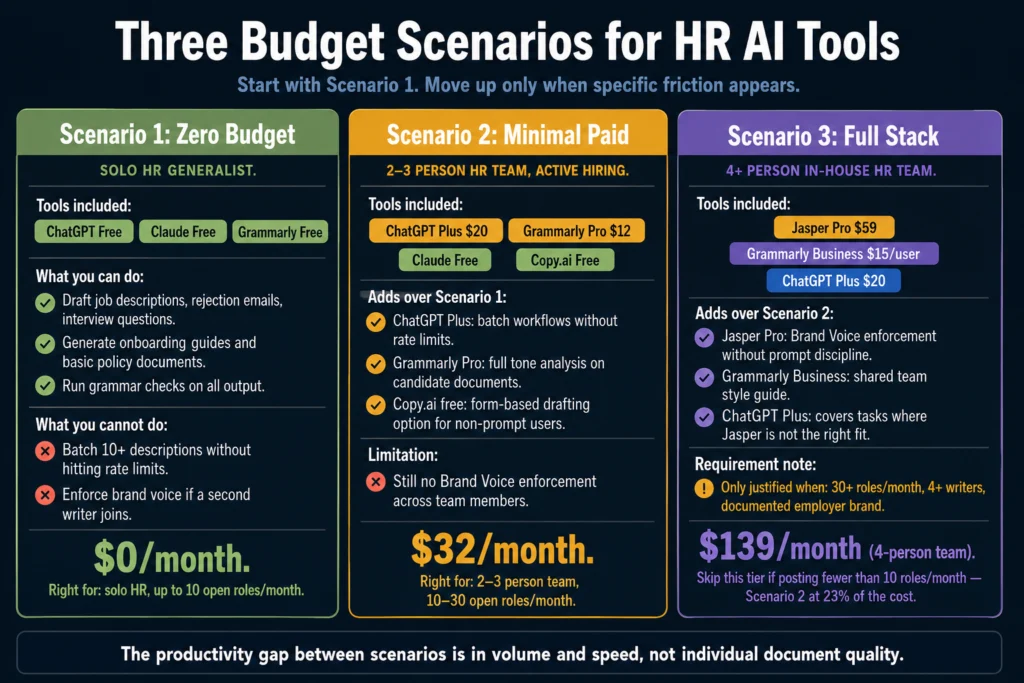
Scenario 1: Zero Budget (Solo HR Generalist)
Stack: ChatGPT free + Claude free + Grammarly free
What you can do:
- Draft job descriptions for any role with a saved prompt template
- Write rejection emails and candidate outreach
- Generate interview question sets with scoring rubrics
- Draft onboarding guides and basic policy documents
- Run basic grammar and tone checks on all output
What you cannot do efficiently:
- Batch 10+ job descriptions in a single session without hitting rate limits
- Work with very long documents (full handbook) without potential context truncation
- Enforce brand voice consistency if another writer joins the team
Monthly cost: $0
Realistic assessment: This stack handles the day-to-day writing needs of a solo HR professional managing up to 10 open roles per month.
The constraints are operational (rate limits, context length) rather than quality-based. Output quality on individual documents is close to paid alternatives.
Scenario 2: Minimal Paid Stack (2–3 Person HR Team, Active Hiring)
Stack: ChatGPT Plus ($20/month) + Grammarly Pro ($12/month) + Claude free + Copy.ai free
What this adds over Scenario 1:
- ChatGPT Plus removes rate limits and gives GPT-5.5 Thinking access, which matters for batch workflows, senior role descriptions, and complex briefs that benefit from the reasoning tier
- Grammarly Pro adds full tone analysis on all candidate-facing documents — the upgrade that most directly affects employer brand quality
- Copy.ai free covers team members who prefer form-based drafting
Monthly cost: $32/month
Realistic assessment: This is the right stack for a two or three-person HR team handling 10 to 30 open roles per month.
The $32/month spend is justified by the reduction in editing time on batch job description workflows (ChatGPT Plus) and the tone consistency improvement on rejection letters and offer letters (Grammarly Pro).
Scenario 3: Full Stack (In-House HR Team, 4+ People, Defined Employer Brand)
Stack: Jasper Pro ($59/month) + Grammarly Business ($15/user/month) + ChatGPT Plus ($20/month)
What this adds over Scenario 2:
- Jasper Pro enforces Brand Voice across all writers without requiring prompt discipline from each team member
- Grammarly Business adds a shared team style guide and admin dashboard — useful for enforcing consistent terminology and preferred phrasing across the HR team
- ChatGPT Plus covers tasks where Jasper is not the right fit (long documents, research-heavy drafts)
Monthly cost (4-person team): ~$139/month
Realistic assessment: Justifiable when brand voice consistency across multiple writers is a documented problem and the team produces enough volume to make the overhead worthwhile.
For a four-person HR team posting 30+ roles per month, the reduction in editing time and revision cycles pays for the tooling.
For the same team posting fewer than 10 roles per month, Scenario 2 covers the need at 23% of the cost.
→ Copy.ai’s free plan (2,000 words/month, no expiry) is the lowest-friction way to test template-based job description drafting before committing to anything.
Related Reading
- Best AI Tools for Writing Job Descriptions
- How to Write 10 Job Descriptions in One Day Using AI
- ChatGPT vs. Claude for HR Writing — A Practical Comparison
- Jasper AI Review for HR Professionals — Is It Worth It?
- Grammarly vs. Jasper for HR Writing — Which Should You Use?
- The Complete Guide to AI Tools for HR Professionals
Frequently Asked Questions
For most HR writing tasks, the quality difference between free and paid AI tools in 2026 is smaller than most vendors would like you to believe. ChatGPT free (GPT-5.5 Instant) and Claude free handle job descriptions, rejection emails, and interview question generation at a level that is adequate for professional use with proper prompting and editing. The constraints of free tools are operational (usage limits, context length, lack of brand voice enforcement), not quality-based. A small HR team can produce professional-quality output on free tools if they invest time in building good prompt templates and maintaining a consistent editing workflow.
Grammarly Pro at $12/month (annual billing). The upgrade from Grammarly free to Pro adds full tone detection, unlimited AI prompts (versus 100/month on free), and full-sentence rewrites. For HR professionals who produce candidate-facing documents — job descriptions, rejection letters, offer letters — the tone analysis catches mismatches between intended and actual register that the free tier misses. At $12/month, this is the lowest-cost upgrade that produces a visible quality improvement on the documents that directly affect employer brand.
If you consistently stay under 2,000 words per month, the free plan is fine. For an HR professional writing two to four job descriptions per month, the 2,000-word limit is close to sufficient. For higher volume, the limit becomes restrictive quickly — a single detailed job description runs 400 to 600 words, which means the free tier covers roughly four descriptions before hitting the cap. The free plan also has no expiry, which makes it a genuine test environment rather than a time-limited trial. Use it to evaluate whether the template-based interface suits your workflow before committing to the $49/month paid plan.
Not significantly, for most tasks. Large HR teams with premium tool stacks have advantages in brand voice consistency and ATS integration — areas where paid tooling genuinely adds value. For the core writing tasks (job descriptions, candidate communications, interview question sets), a small HR team using free tools with good prompt discipline produces output that is comparable to larger teams using Jasper or similar platforms. The productivity gap is in volume and speed, not quality. A two-person HR team cannot produce 50 job descriptions per week without hitting free tier rate limits — but a two-person HR team should not be trying to do that regardless.
A minimum of 60 days of actual use before evaluating any paid upgrade. This gives you time to build prompt templates, establish a consistent workflow, and identify the specific friction points that free tools create. Most HR professionals who switch to paid tools do so because of a specific operational pain point — rate limits during a high-volume hiring period, context truncation on a long handbook project, brand voice drift when a second writer joins the team. Upgrade in response to a specific friction point, not because a vendor’s marketing says you should.
Conclusion
The case for starting with free AI tools and upgrading only when specific friction points emerge is strong.
The free stack — ChatGPT free, Claude free, Grammarly free — covers the vast majority of HR writing tasks with quality that is close to paid alternatives on individual documents.
That finding holds up in practice: based on what the Ailovyu team has tested and observed across small HR teams, the friction points that actually justify paid upgrades are specific and predictable: rate limits during batch workflows, tone analysis on candidate-facing documents, and brand voice enforcement across multiple writers.
The two upgrades that earn their cost for most small HR teams, in order of priority: Grammarly Pro at $12/month for tone analysis on candidate-facing documents, and ChatGPT Plus at $20/month for removing rate limit friction during batch workflows.
Everything else — Jasper, Copy.ai Pro, Claude Pro — becomes relevant only when specific use cases create specific operational problems that free tools demonstrably cannot solve.
Start free. Identify the friction. Upgrade precisely.
We research and test AI tools so you can make informed decisions before spending money on them. Every review, comparison, and tutorial on this site is based on actual use, not vendor marketing.
Learn more on our About page.
Tool pricing verified May 2026 from vendor websites. Grammarly is now called Grammarly Pro at the individual paid tier — some references still use the older “Premium” name. Affiliate links in this article earn a commission at no extra cost to you.