
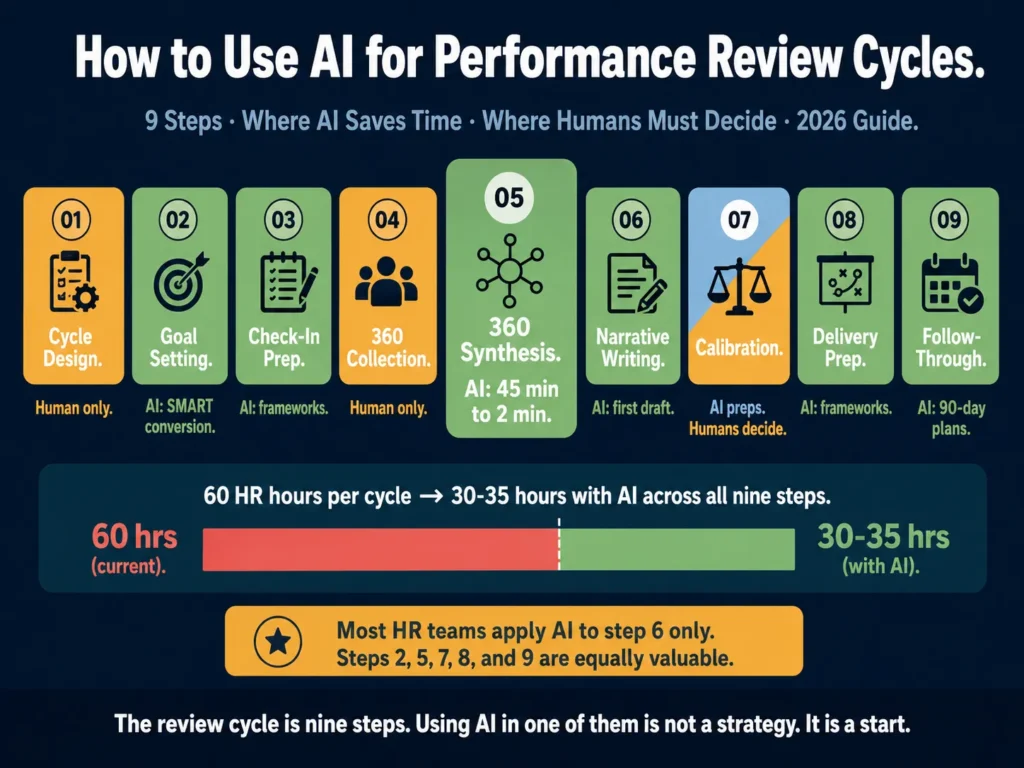
- Most HR teams use AI only for the narrative writing step of performance reviews. That misses eight other stages in the cycle where AI saves time.
- AI adds the most value at goal setting, 360 feedback synthesis, and self-assessment structuring. These are where managers spend the most undocumented time.
- Through 2026, Gartner predicts 20% of organizations will use AI to flatten management structures, eliminating more than half of current middle management positions. Performance cycles increasingly need to measure AI-human collaboration, not just individual output.
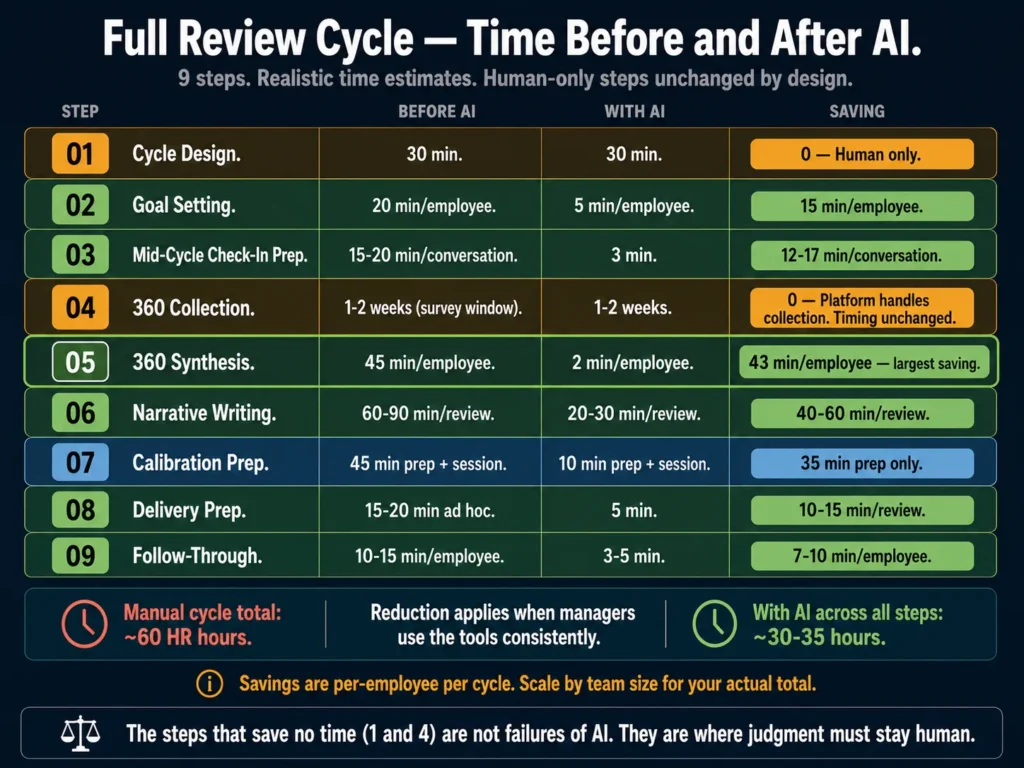
- The tutorial covers nine steps: cycle design, goal setting, mid-cycle check-ins, 360 collection, 360 synthesis, narrative writing, rating calibration, delivery prep, and follow-through.
- Two legal compliance areas require attention in 2026: the EU AI Act’s provisions on AI in employment decisions, and NYC Local Law 144 for organizations in New York City.
Most articles on AI and performance reviews focus on one thing: writing the narrative.
HR teams spend 30 minutes generating a paragraph about an employee’s contributions when they could spend 5 minutes.
That matters. But the narrative is one step in a 9-step cycle that runs for 60 to 90 days per year.
Each step creates administrative load. AI reduces that load at multiple points, not just one.
This guide walks through each step, explains what AI does well there, and gives you the prompt or workflow to use.
The writing step gets covered here in summary and links to Article 15 for the full treatment.
- Step 1: Design Your Review Cycle Before Adding AI
- Step 2: AI-Assisted Goal Setting at Cycle Start
- Step 3: Mid-Cycle Check-In Prompts
- Step 4: Collecting 360 Feedback
- Step 5: AI-Assisted 360 Feedback Synthesis
- Step 6: Manager Narrative Writing
- Step 7: Rating Calibration
- Step 8: Delivery Preparation
- Step 9: Post-Review Follow-Through
- Two Legal Areas to Check in 2026
- Related Reading
- Frequently Asked Questions
- Conclusion
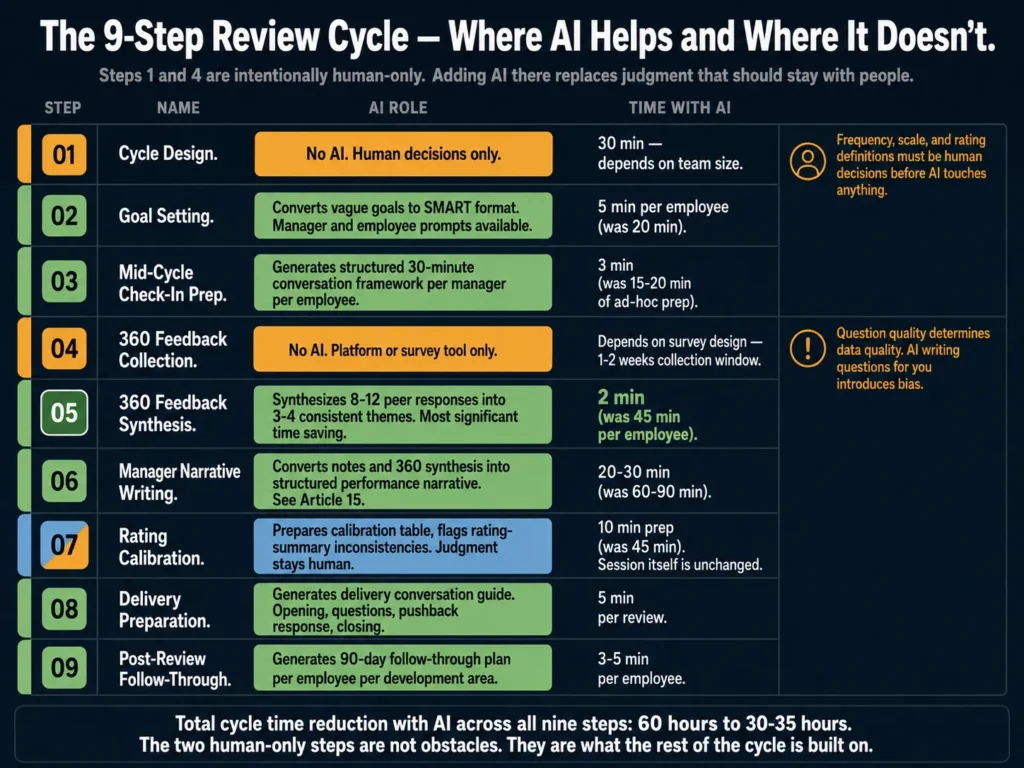
Step 1: Design Your Review Cycle Before Adding AI
This step has no AI in it. You make decisions here that determine how useful AI will be later.
Decide on three things before you open any tool:
Review frequency. Annual reviews produce the worst data because managers evaluate on what they remember, not what happened.
Quarterly check-ins with a formal annual review produce better data and reduce recency bias.
If you are currently running annual-only reviews, adding one mid-year check-in improves the quality of the annual evaluation significantly.
Self-assessment structure. Open-ended self-assessments (“describe your performance this year”) produce text that is hard to calibrate across employees.
Structured self-assessments with 4 to 6 specific questions produce responses that managers and HR can compare. Define those questions before the cycle opens.
Rating scale. A 5-point scale with clear definitions for each level produces more useful data than a 3-point scale.
Define what a “3” means in concrete behavioral terms before anyone is asked to rate anyone.
If managers cannot explain the difference between a 3 and a 4 without guidance, your scale is too vague.
Document these decisions and share them with all managers before the cycle opens.
AI cannot compensate for an unclear process. It accelerates whatever process you have, good or bad.
Step 2: AI-Assisted Goal Setting at Cycle Start
Goal setting is where most cycles fail before they start. Managers write vague goals. Employees write vague goals.
At the end of the year, no one can objectively evaluate them.
AI converts vague goals into SMART ones, quickly.
Prompt for converting a manager’s vague goal into a SMART goal:
Convert this vague performance goal into a SMART goal for an employee.

Employee role: [TITLE AND LEVEL]
Manager's original goal: [PASTE GOAL AS WRITTEN]
Review period: [START DATE] to [END DATE]
One piece of context about the team's current priorities: [CONTEXT]

Write the SMART goal in plain language. Include:
- Specific: what exactly will the employee do or produce?
- Measurable: what number, percentage, or observable outcome shows completion?
- Achievable: is this realistic for this role and period?
  Flag if the original goal seems out of scope.
- Relevant: connect it to one team or company priority.
- Time-bound: by what date or milestone?

Write one sentence that a manager could read in 30 seconds
and a new employee would understand without context.Prompt for helping an employee write their own goals:
Help me write 3 SMART performance goals for my review period.

My role: [TITLE AND LEVEL]
Department: [DEPARTMENT]
My three priority areas this cycle: [LIST]
One ongoing project I will work on: [PROJECT]
One skill I want to develop: [SKILL]

For each priority area, write one SMART goal in plain language.
Keep each goal under 50 words.
Do not use corporate jargon.You can batch this. If you are HR setting up a review cycle for 40 managers, share the goal prompt as a template.
Ask managers to run their direct reports’ draft goals through the prompt and submit the SMART version. Review time per manager drops from 20 minutes to 5.
Step 3: Mid-Cycle Check-In Prompts
Quarterly or mid-year check-ins are the step most managers skip because they do not know what to say.
AI gives them a structured conversation framework, not another written report to file and forget.
Prompt for mid-cycle check-in prep:
Generate a 30-minute mid-cycle check-in framework for a manager
meeting with a direct report.

Employee name: [NAME]
Role: [TITLE]
Goals set at cycle start: [PASTE 3-4 GOALS]
One thing that has changed since cycle start (new project,
team change, priority shift): [CONTEXT]

Produce:
- 4 questions the manager should ask, in order
- One question the employee should ask the manager
- A note-taking template with space for each question
- A "next steps" field with 3 blank lines

Tone: direct and practical. This is a working conversation,
not a formal evaluation.Run this once. Save the output as a template. Distribute it to all managers before each mid-cycle period.
The consistency this creates across your organization is worth more than any individual conversation improvement.
Step 4: Collecting 360 Feedback
Before AI touches 360 feedback, you need to collect it correctly. Three things determine whether 360 data is useful:
Response quality depends on question quality. “Rate this person’s communication skills on a scale of 1 to 5” gives you a number with no context.
“Describe a specific situation where this person’s communication affected the outcome of a project” gives you something a manager can use.
Anonymity affects honesty. If respondents believe their specific feedback can be traced back to them, they inflate ratings. Use a platform that aggregates responses before managers see them.
Sample size affects reliability. Three peer responses produce unreliable data. Seven to ten responses produce patterns you can act on.
Platforms like Lattice, Leapsome, and Culture Amp collect structured 360 feedback and feed it directly into AI synthesis, reducing manual data handling.
If you are not on one of those platforms, you can run 360 collection through a Google Form or a similar survey tool and handle the synthesis in Step 5 manually.
Step 5: AI-Assisted 360 Feedback Synthesis
This is where AI saves the most time in the review cycle, and the use case is straightforward. You have 8 peer feedback responses averaging 150 words each.
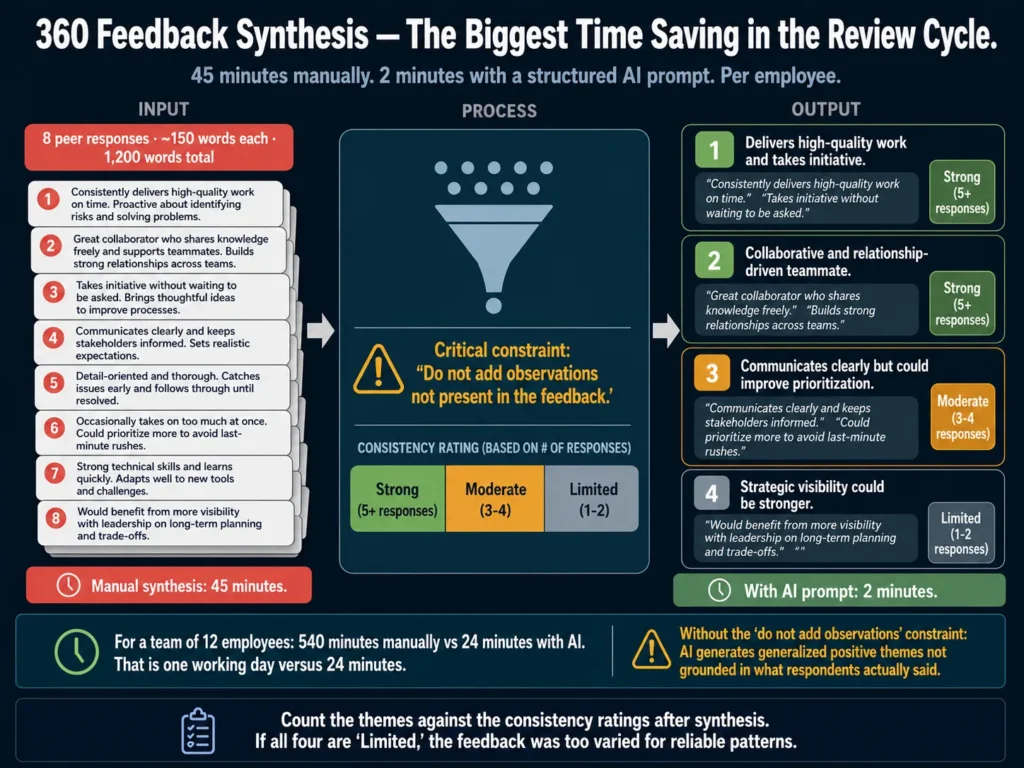
A manager needs to synthesize them into 3 to 4 themes within 15 minutes. That is not realistic manually. AI does it in 2 minutes.
Prompt for synthesizing 360 feedback:
You are an HR analyst synthesizing 360 feedback for a performance review.

Employee name: [NAME]
Role: [TITLE]
Review period: [PERIOD]

Below are peer and manager feedback responses. Synthesize them into
3 to 4 clear themes.

For each theme:
- State the theme in one sentence
- Quote 2 specific examples from the feedback (use exact phrases,
  keep them short)
- Rate the consistency of this theme across responses:
  strong (5+ responses mention it), moderate (3-4), or
  limited (1-2 responses)

Important: do not add observations not present in the feedback.
Do not soften negative themes. Report what the data shows.

Feedback responses:
[PASTE ALL RESPONSES HERE]The instruction “do not add observations not present in the feedback” is critical. Without it, Claude and ChatGPT generate generalized positive themes that are not grounded in what respondents actually said. Add this constraint to every 360 synthesis prompt.
One practical check: after AI generates the synthesis, count how many themes it identified. If it produced 4 themes and you gave it 8 responses averaging 150 words each, at least 2 of those themes should have “strong” consistency ratings.
If all four are “limited,” the feedback may have been too varied for reliable synthesis, or the employee had a genuinely mixed peer perception that deserves reflection in the review.
Step 6: Manager Narrative Writing
This step is covered in full in Best AI Tools for Performance Review Writing. The short version:
Use the master prompt from Article 15. Give the AI specific, dated observations from the manager’s notes. Add the 360 synthesis from Step 5.
Run the output through a specificity check: every strength and development area should cite evidence from the actual notes or feedback, not general claims.
The most common failure here: managers provide general inputs and accept general outputs.
“Strong communicator” without a single named example is not useful to the employee and is legally weak in a dispute. Article 15 covers how to prevent this.
Step 7: Rating Calibration
Calibration is where AI reaches its clearest limit. The purpose of calibration is to ensure that a “3” from one manager means the same thing as a “3” from another manager.
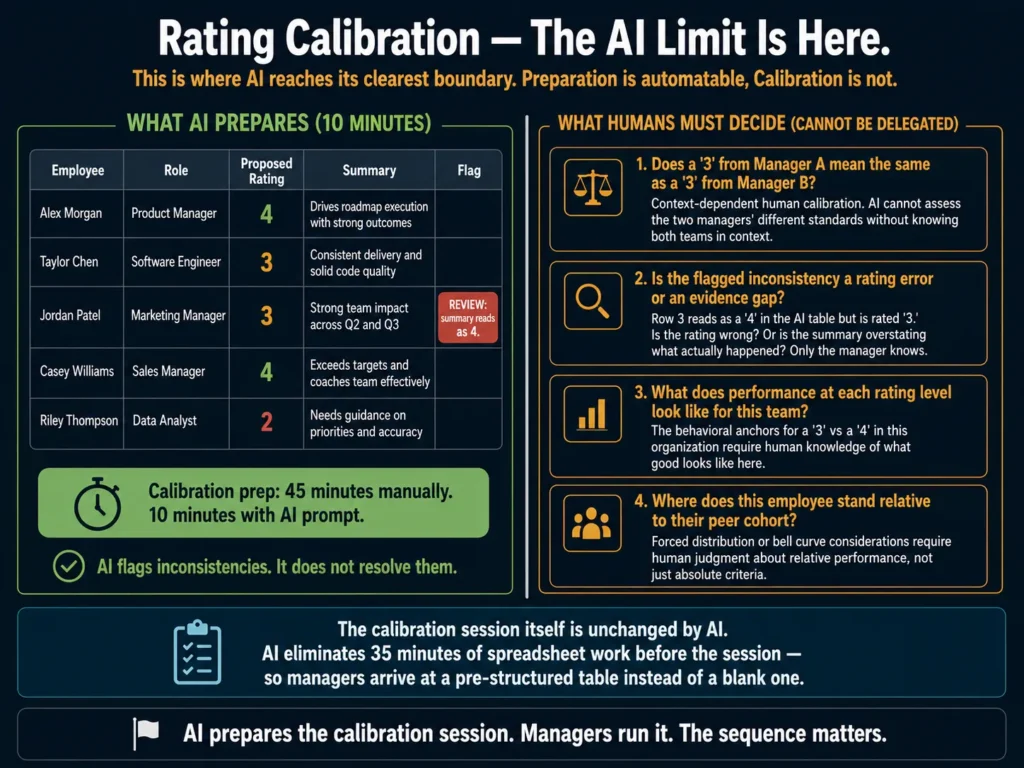
That requires human judgment about people in context. AI cannot do it.
What AI can do is prepare the calibration session.
Prompt for calibration session prep:
Prepare a calibration summary for a team of [NUMBER] employees
being reviewed by [NUMBER] managers.

Below are the employee names, their roles, their proposed ratings,
and a one-line summary of their performance from their review.

Format the output as a table with:
- Employee name
- Role
- Proposed rating
- One-sentence performance summary
- Flag column (mark "review" if the rating seems inconsistent
  with the summary provided)

Employee data:
[PASTE DATA]

Note any cases where the one-sentence summary sounds like a
"4" but the proposed rating is a "3", or vice versa.
Do not change any ratings. Only flag inconsistencies for
discussion.This prep work used to take an HR leader 45 minutes before each calibration session.
With AI, it takes 10 minutes. The session itself requires human judgment. The preparation does not.
Step 8: Delivery Preparation
Most managers treat the written review as the finish line and spend no time preparing for the actual delivery conversation.
They improvise. That produces inconsistent experiences across the organization, and employees feel it.
AI generates a structured delivery framework in minutes.
Prompt for review delivery prep:
Create a 20-minute review delivery conversation guide for a manager.

Employee name: [NAME]
Overall rating: [RATING]
Key strength from the review: [ONE SENTENCE]
Key development area from the review: [ONE SENTENCE]
One specific goal for the next cycle: [GOAL]
Anticipated employee reaction (if known): [POSITIVE / NEUTRAL /
LIKELY TO PUSH BACK / UNKNOWN]

Produce:
- Opening statement (2-3 sentences, not "let me start by saying...")
- Three questions to ask the employee during the conversation
- One response if the employee disagrees with the rating
- Closing statement that connects the review to the next cycle
- Things to avoid saying (3 specific phrases that create problems)Run the delivery framework through Grammarly before the conversation. Not for grammar. For tone.
A delivery opening that reads as “formal” will land differently in a room than one that reads as “confident” or “warm.” Catching that before the conversation matters.
Grammarly Pro’s tone detection applies to spoken scripts, not just written documents. At $12/month, it is a practical tool for review delivery preparation.
Step 9: Post-Review Follow-Through
The review cycle does not end at delivery. It ends when the actions from the review are reflected in how the employee is managed over the next 90 days.
AI cannot do the follow-through for you. It can structure it.
Prompt for generating a post-review action plan:
Create a 90-day follow-through plan for a manager after a
performance review.

Employee name: [NAME]
Role: [TITLE]
One key development area identified in the review: [AREA]
One goal set for the next cycle: [GOAL]
Rating received: [RATING]

Produce:
- Weeks 1-4: What the manager should observe and document
- Weeks 5-8: One mid-point check-in question and what a
  positive or concerning response looks like
- Weeks 9-12: How to assess whether the development area
  is improving

Keep this practical. No abstract frameworks.
Format as a 3-section checklist the manager can actually use.If you are generating follow-through plans for a team of 10 to 15 employees after a review cycle, Copy.ai’s workflow automation lets you build this as a template with variable fields.
One manager brief generates one plan. You run 15 in a session.
Copy.ai’s workflow tools are useful for batch-generating follow-through plans. The free plan (2,000 words/month) covers a small team test before committing.
Two Legal Areas to Check in 2026
EU AI Act compliance. If your organization has employees in the EU, the EU AI Act applies in two separate phases for employment contexts.
Since February 2025, certain AI practices have been prohibited outright: biometric categorization of employees and emotion recognition in workplace settings.
AI systems used to evaluate or make decisions about employees are classified as high-risk under Annex III. The compliance deadline for these high-risk employment AI systems was originally 2 August 2026.
The EU’s political agreement of 7 May 2026 on the AI Act Omnibus proposes extending that deadline to 2 December 2027, but formal adoption has not yet occurred.
Treat 2 August 2026 as the operative deadline until the Omnibus is formally published in the Official Journal.
If your performance management platform uses AI to generate or recommend ratings, verify compliance with your legal team before August 2026.
NYC Local Law 144. If you have employees or conduct hiring in New York City, the bias audit and candidate disclosure requirements extend to automated employment decision tools.
Performance management tools that use AI to generate ratings or assessments may fall under this law’s scope.
Confirm with your legal team which specific features in your platform qualify as automated employment decision tools under the NYC definition.
For more on AI legal compliance in employment, read Can You Use AI-Generated Job Descriptions Legally? and AI Bias in Hiring: What HR Teams Need to Know.
Related Reading
- Best AI Tools for Performance Review Writing
- AI Bias in Hiring: What HR Teams Need to Know
- How to Write a 30-60-90 Day Onboarding Plan with AI
- How to Build an AI Prompt Library for HR Teams
- AI for HR Communications and Documentation: The Complete Guide
Frequently Asked Questions
Article 15 covers writing tools for the narrative drafting step specifically. This article covers all nine steps in a complete review cycle. If you want to know which AI tool to use for drafting a performance narrative, read Article 15. If you want to understand how to use AI across the full cycle from goal setting to follow-through, this is the article.
No, and you should not want it to. The steps where AI saves time are administrative: structuring goals, synthesizing feedback, preparing calibration tables, drafting narrative language. The steps that require human judgment are different: evaluating whether an employee actually met a goal, deciding what a rating means in context of the team, and delivering feedback in a way that motivates rather than demoralizes. AI can flag risk, but managers and HR still need to decide what fair feedback actually means. Organizations that try to use AI to replace manager judgment in reviews end up with legally exposed processes and employee relations problems.
Lattice, Leapsome, and 15Five are the strongest mid-market options for full-cycle AI-assisted performance management. Leapsome’s AI connects directly to goal data, 1:1 notes, and prior reviews to generate contextualized narratives. Lattice’s AI copilot handles review drafts and has recently added calibration support. 15Five focuses on continuous performance management rather than annual review cycles. For enterprise organizations, Workday and SAP SuccessFactors have added AI features, though these are more useful for analytics than for narrative drafting. For tool comparisons within those categories, read Best AI Tools for Performance Review Writing.
Proactively. If a manager used AI to draft a review narrative, the manager should own the content. The review should reflect the manager’s actual assessment, supported by specific evidence from the year. If an employee questions whether a review was AI-generated, the right response is not to deny it. Confirm that AI assisted with drafting and that every observation in the review is based on documented evidence the manager can cite. A manager who cannot cite specific evidence for any claim in the review has a problem regardless of whether AI was involved. The practice to avoid: approving AI-generated reviews without reading them carefully or substituting evidence for general claims.
Some will. This is already happening. The practical response is to design self-assessment questions that are specific enough to make generic AI responses obvious. “Describe your three most impactful contributions this year” produces AI-friendly responses. “Describe one specific project where you made a decision your manager did not expect, what happened, and what you would do differently” produces responses that are harder to generalize. When self-assessments are used in calibration or evaluation, managers should treat suspiciously fluent or generic responses as requiring a follow-up conversation, not as evidence of high performance.
Conclusion
A performance review cycle is nine steps. Most HR teams apply AI to one of them.
The savings are real at each stage. Goal setting runs faster when AI converts vague drafts into structured targets. 360 synthesis drops from 45 minutes to 10 minutes.
Calibration prep that used to take an hour takes less than 15 minutes. Delivery prep, post-review planning, and mid-cycle frameworks each have a prompt that works and takes fewer than 5 minutes to run.
None of this replaces the manager’s role. Judgment, calibration, and delivery still require a person. AI reduces the administrative load so managers can focus on the parts only they can handle.
If your review cycle takes 60 hours of HR time per cycle, applying AI across all nine steps can realistically cut that to 30 to 35 hours. That is not a guaranteed number.
It depends on your team size, your current process maturity, and how consistently managers use the tools you give them.
But the reduction is achievable, and it is available with tools most HR teams already have access to.
The nine-step framework and prompts in this article reflect what the Ailovyu team has tested and refined across performance review cycles at organizations of different sizes.
We research and test AI tools so you can make informed decisions before spending money on them. Every review, comparison, and tutorial on this site is based on actual use, not vendor marketing.
Learn more on our About page.
Statistics sourced from Peoplebox.ai Performance Review Cycle Guide (April 2026), Gartner Newsroom “Gartner Unveils Top Predictions for IT Organizations and Users in 2025 and Beyond” (October 22, 2024), and Engagedly AI in Performance Reviews 2026 analysis. EU AI Act timeline sourced from artificialintelligenceact.eu, Holland & Knight (April 2026), and Gibson Dunn (May 2026). Affiliate links in this article earn a commission at no extra cost to you. This article is for informational purposes and does not constitute legal advice.